


Introduction
A structural shift is taking place in the payments industry, whose underlying architecture has remarkably barely changed in decades.
Every layer of today’s payment stack assumes a human at both ends of every payment, which for most of human history has been true, up until recently. Increasingly, however, AI agents are now facilitating economic value, slowly but surely gaining more autonomy in the payments loop, to the point where they are initiating payment flows themselves. In some contexts, these flows involve AI agents moving value on behalf of their human operators to perform simple consumer shopping tasks. This has been tried with initiatives like Instant Checkout in ChatGPT. In other contexts, AI agents are themselves making decisions to pay for things, particularly resources required for them to complete specific workflows. This means that alongside the human-to-human payment flow now sit the human-to-agent and agent-to-agent payment flows, and this seemingly simple shift is already reshaping how existing infrastructure providers compete.
Some projections forecast trillions in agentic commerce-driven volume over the next 5-10 years, and while today’s numbers reflect that we are in the early stages of this cycle, over a long enough time horizon the projections look at least directionally correct. And as the development pace of frontier labs research over the past several years has demonstrated, a lot of things happen in AI much quicker than expected. More importantly, in an industry whose incumbents have absorbed every wave of innovation for the past seventy years, the opportunity for a differently positioned player to own more of the stack does not come along very often.
To understand the broader impact of this transformation, it helps to first understand what payments actually look like today. What feels instant to a consumer actually moves through four layers of infrastructure and five or more companies before a merchant ever sees a cent. This is often referred to as the “payments layer cake”, where each layer represents a different party in the payments flow.
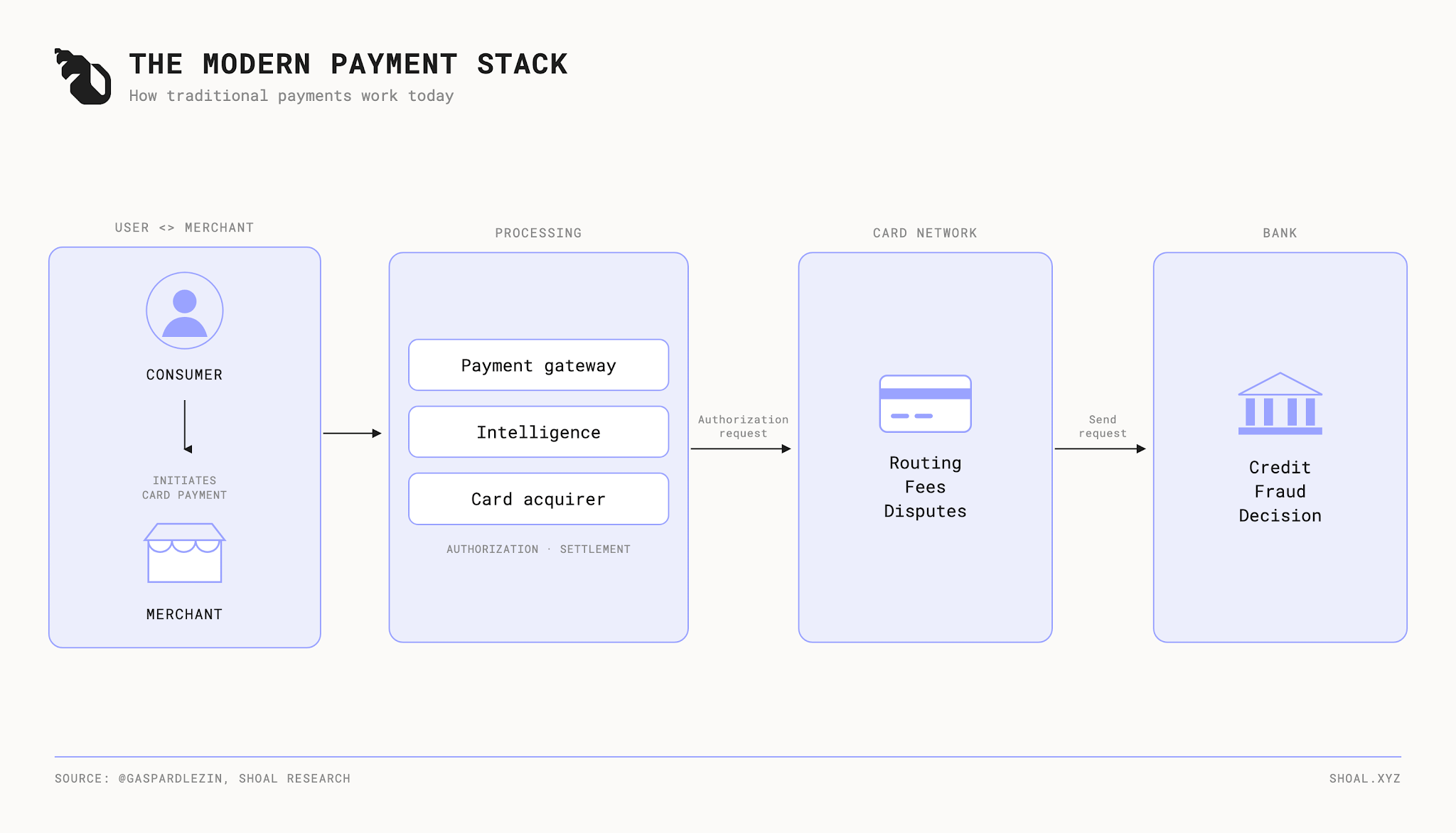
When a consumer taps their card at checkout, the transaction moves through four distinct layers. At the top, the consumer initiates a card payment to the merchant. It drops into the processing layer, where a gateway (e.g., Stripe) encrypts and forwards the data, fraud and dispute intelligence runs in parallel, and a card acquirer (e.g., Adyen) prepares to receive funds on the merchant's side. From there, the authorization request hits the card network layer, where a Card Network like Visa or Mastercard handles routing, enforces scheme rules, and passes the request down to the banking layer. The issuing bank makes the credit and fraud decision and sends an approve or decline back up the chain. Authorization completes in under roughly two seconds, while settlement, the actual movement of funds back through the network to the acquirer and into the merchant's account, takes another one to two business days.
Each layer of this payment stack serves a fundamentally different customer; issuers extend credit to consumers, acquirers give merchants a way to accept payment, and the fraud and dispute layers sort out the mistakes people inevitably make. Serving all of these customers at once is beyond the reach of any single company; hence, no one has owned the whole stack. But a lot of this logic starts to break down when humans are further removed from the payments loop and, in their place, autonomous software programs take on a growing share of the decisions and transactions within it.
The payments industry has taken in one innovation after another, and the basic architecture has survived nearly all of them. When the credit card was introduced, it got rid of the need to carry cash, but instead of replacing any of the existing arrangements it simply added a consumer credit feature on top of the original banking system. The internet went even further by completely altering the way people contacted merchants and at the same time created a kind of fraud exposure that had never been there before, although the trust mechanisms developed in response were still based on the same four-party model. Likewise, companies such as Stripe and the fintechs that came after them, who reduced a large part of the system to a single API call, left the fundamental acquiring, issuing, and settlement processes unchanged.
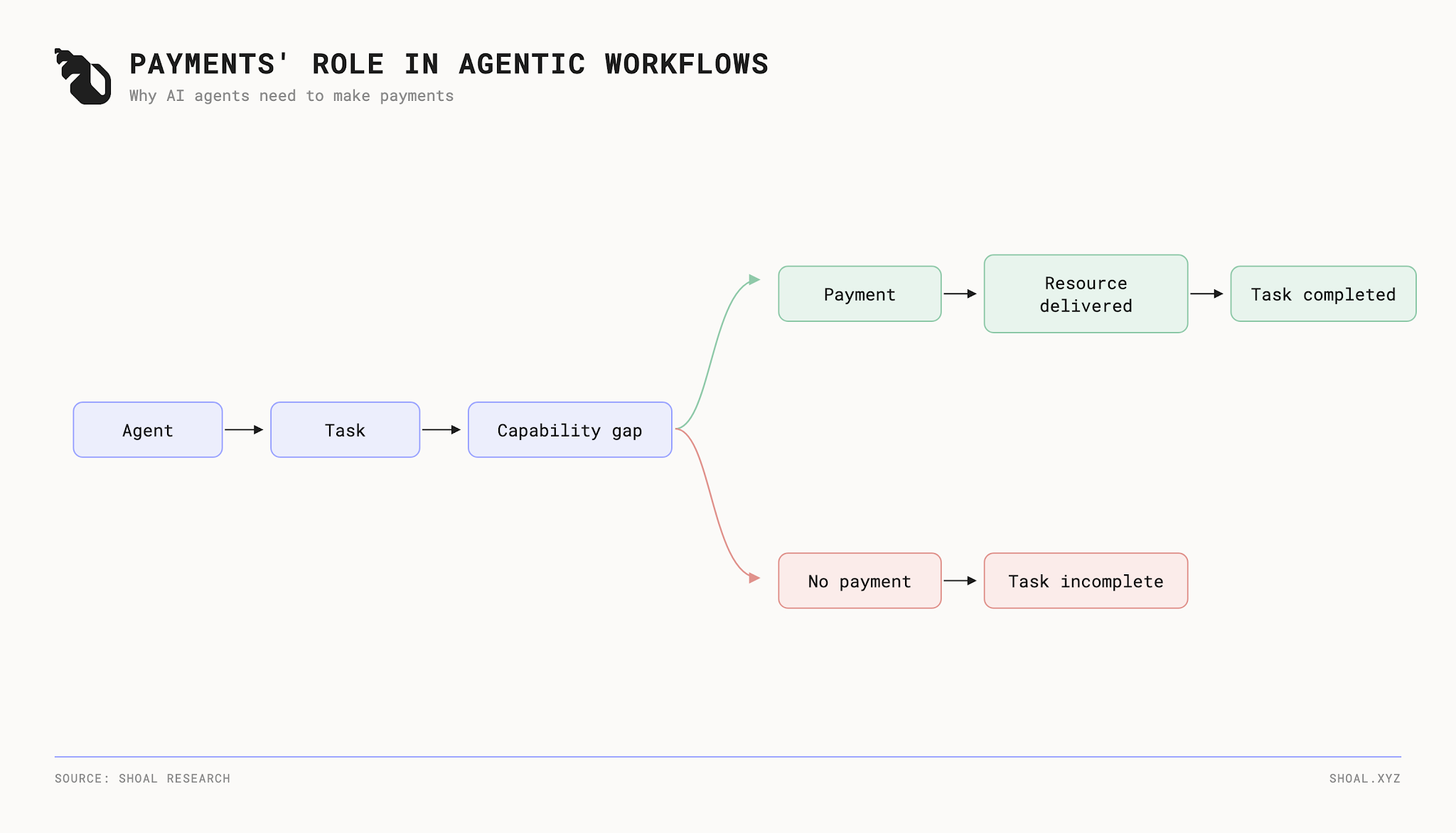
Every one of these developments, though, shared the same premise: optimizing a stack built for human consumers. AI agents break that premise, as they don't carry wallets, don't click checkout buttons, and don't face the cognitive constraints the human payments stack was designed around. For an agent, a payment is a function call within a workflow, where it requests a resource, receives a price, completes the payment, and moves to the next task. The human payment stack will not hold its shape around a loop that fast and frequent, especially at scale.
The Path Forward Is A Vertical One
Vertical integration in payments, owning as much of the stack as possible, is not a new idea. Apple owns the iPhone, the Wallet app, and the tap-to-pay experience. Shopify runs the store and the checkout, processes the payment, and even lends money to its shops. Block controls everything from the card reader in a merchant's hand to the Cash App on a consumer's phone. But each of them still operates inside the human system, where every layer they own serves a specific customer segment with specific needs
Agents change the motive for integrating, because they change fundamentally what a customer is. An agent needs a place to keep its money, a way to send payments, and a way to find goods and services to buy. Not much else is needed beyond those key functions, so the payments stack it depends on is far smaller than the one built for human shoppers.
The question then becomes, given a narrower, purpose-built payments stack, which business in payments today can vertically integrate, and how far? The human payment stack is split across extending credit, accepting funds, routing the transaction, and settling it, each piece owned by a different company. The agent stack has no such divisions. An agent pays in the same dollars from start to finish, and the wallet, the network, and the shop are just ways of moving them, swappable for one another. The dollars make up the payment itself, giving the issuer of those dollars a particularly important role in agentic commerce.
Few players sit in this position, and while banks hold the actual dollars in the payment flow, an agent can't pay with a dollar sitting in a bank account. One emerging solution is to let the agent pay with a stablecoin, a digital version of a dollar that is issued on a blockchain. Bridging the two is a narrow business, where a company takes in a real dollar, holds it in reserve, and puts a digital dollar into circulation against it. From that point, the digital dollar is the company's product, and the rules it writes for how that dollar is made, moved, or frozen follow it everywhere it goes. That is why we believe a stablecoin issuer in particular is uniquely positioned to verticalize agent payments and capture the upside.
The Stablecoin Moat For Agentic Commerce
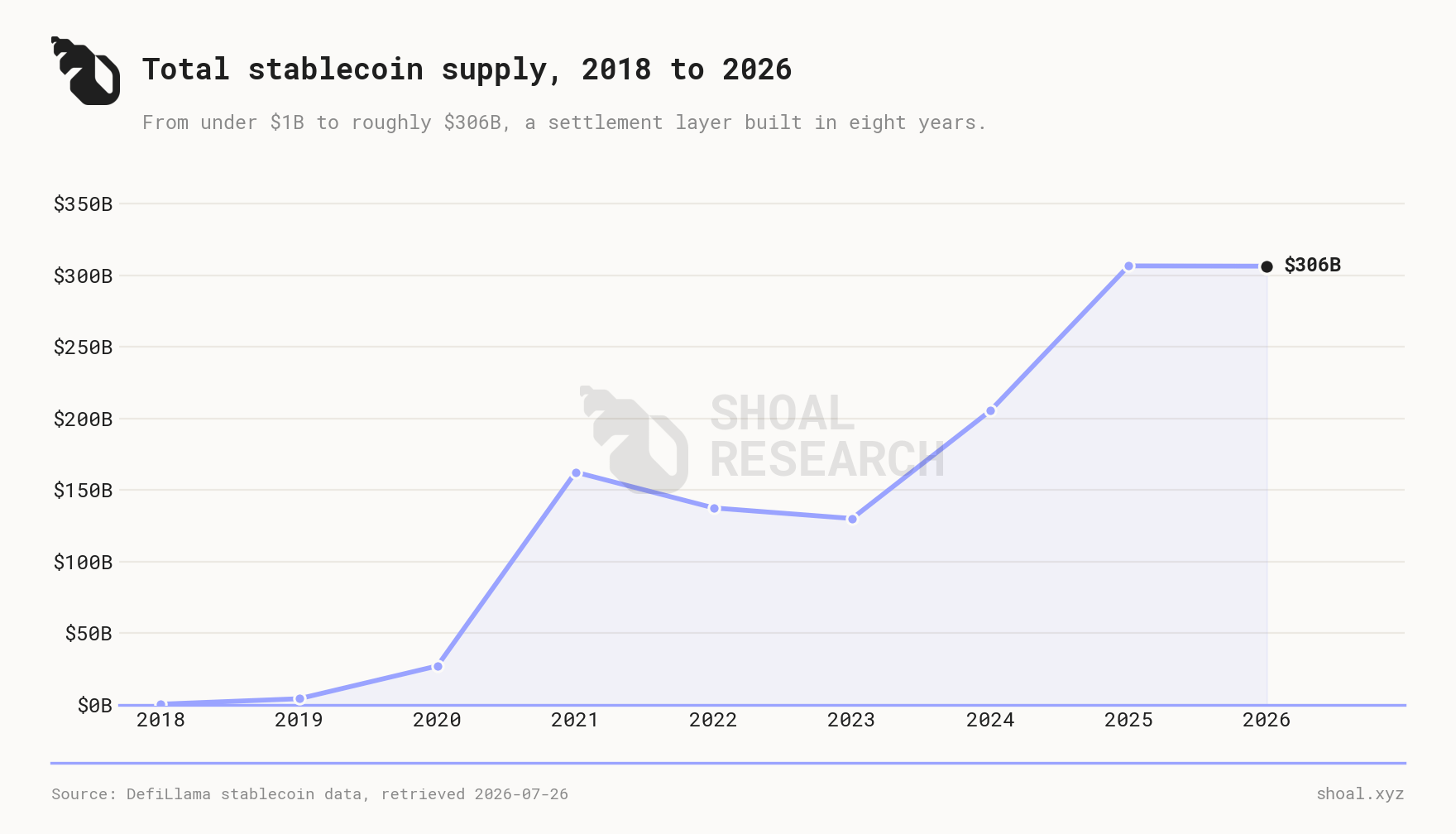
A stablecoin is, sparing some technical details, a piece of software programmed to maintain the value of a stable unit of exchange, most commonly a fiat currency like the US Dollar. A function call is made to a smart contract (another piece of software) and in turn a stablecoin is either minted or redeemed. Stablecoins are held and transacted through digital wallets; interfaces that bundle together a public key for sending and receiving transactions with a private key for authorization. The total circulating stablecoin supply sits at $315B at the time of writing as per Artemis.
The two primary reasons stablecoins are particularly well-suited for agents are economic and structural. A stablecoin transaction is a redistribution of balances on a blockchain, with no intermediary charging a fee at each layer between sender and recipient, which makes it orders of magnitude cheaper than legacy payment rails. The only resource consumed is the computing power needed to update the balance, paid as a gas fee that now sits in the sub-cent range across the majority of the leading chains by DEX volume.
Beyond cost, stablecoins have properties that fit how agents actually operate. Speed and accessibility are the obvious ones, since transactions settle in seconds and run around the clock. The more distinctive advantage is programmability. Stablecoins are issued and redeemed by smart contracts, pieces of code that execute automatically when predefined conditions are met, and those conditions, a collateral requirement, a spending limit, can be written directly into the contract. An agent can control its own wallet and sign transactions itself, so no human credential is needed at the payment layer. A payment becomes a function call in code, triggered the moment a condition is met, with no human initiating it.
That automation removes the need for counterparty trust, meaning an agent does not have to rely on a counterparty's legal representation or a jurisdiction's enforcement. A contract that says release payment when condition X is met will release payment every single time condition X is met. Most companies in the payments stack own one layer, earning revenue by performing a function on an asset they don't control in any meaningful way. A stablecoin issuer is different because the asset is their core product, which has two key implications.
The first is the impact around the business model; when a user mints a stablecoin, they hand over one real dollar and receive one stablecoin. The issuer invests that dollar in short-term yielding assets like US Treasury bills and keeps the interest, which accrues on every dollar in circulation whether or not it moves, as the issuer earns interest on the total circulating stablecoin supply.
AI agents structurally expand that supply base, as their wallets need to maintain a funded balance to operate. Payments execute against the balance held in a wallet at the moment a condition triggers, and insufficient funds fail the transaction and stall the workflow. Operators fund wallets in advance and replenish them periodically, and that balance earns the issuer interest income for the duration of the agent's operating period.
Second, a stablecoin issuer has a unique structural advantage in that it controls the underlying monetary primitive. When an issuer deploys a stablecoin, it writes the smart contract that governs how the coin is minted, redeemed, frozen, and transferred. Subsequently, every wallet that holds it, every rail that moves it, every orchestrator that routes it, is executing against rules the issuer wrote. If the issuer incorporates a programmable condition (e.g. a spending limit, transfer restriction, collateral requirement etc.) that condition applies everywhere the asset exists, because it is in the contract itself.
Having such control over the asset in a payment flow compounds particularly in agentic commerce, as agent transactions are steps in a workflow where the conditions on a payment depend on what happened before it and what needs to happen next. Those conditions need to be encoded somewhere, and on stablecoin rails they live in the asset contract, so the issuer who writes the contract defines the terms on which every autonomous transaction settles.
Controlling the asset is the entry point, the foundation every other layer builds on, and every developer, operator, and business in agent payments starts there. The moat forms one level up, in what accumulates on top of the asset. A stablecoin is too simple an instrument for its issuers to differentiate on. USDC and USDT are both dollar-denominated, both redeemable one for one, both settled on mostly the same public blockchains, and a developer choosing between them has no reason to prefer one on the asset alone. Hence why the choice for developers and merchants comes down to which asset carries the best infrastructure to build on. Each layer added on top expands what developers can build, shrinks what they have to figure out themselves, and widens the gap between that platform and any alternative. Few issuers are positioned to build that, and fewer still have meaningful scale.
Each layer of infrastructure added on top of the asset expands what developers can build, reduces what they have to figure out themselves, and widens the gap between that platform and any alternative. There are not many stablecoin issuers positioned to build that, and even fewer with meaningful scale.
Stablecoin Supply vs Volume vs Transactions Count
Identifying which stablecoin issuer is actually best-positioned to capture the upside of agentic commerce starts with evaluating them against the three key stablecoin metrics. Supply is how much of an asset is held at a point in time, volume is the dollar value of what moves, and transaction count is how many times value moves regardless of size. In a human payment system the three travel together, since more supply means more potential volume, and volume and count scale in tandem because human transactions cluster around a meaningful dollar amount.
Tether's USDT circulates around $185B against USDC's $73B, a lead it has held through every market cycle since 2020.
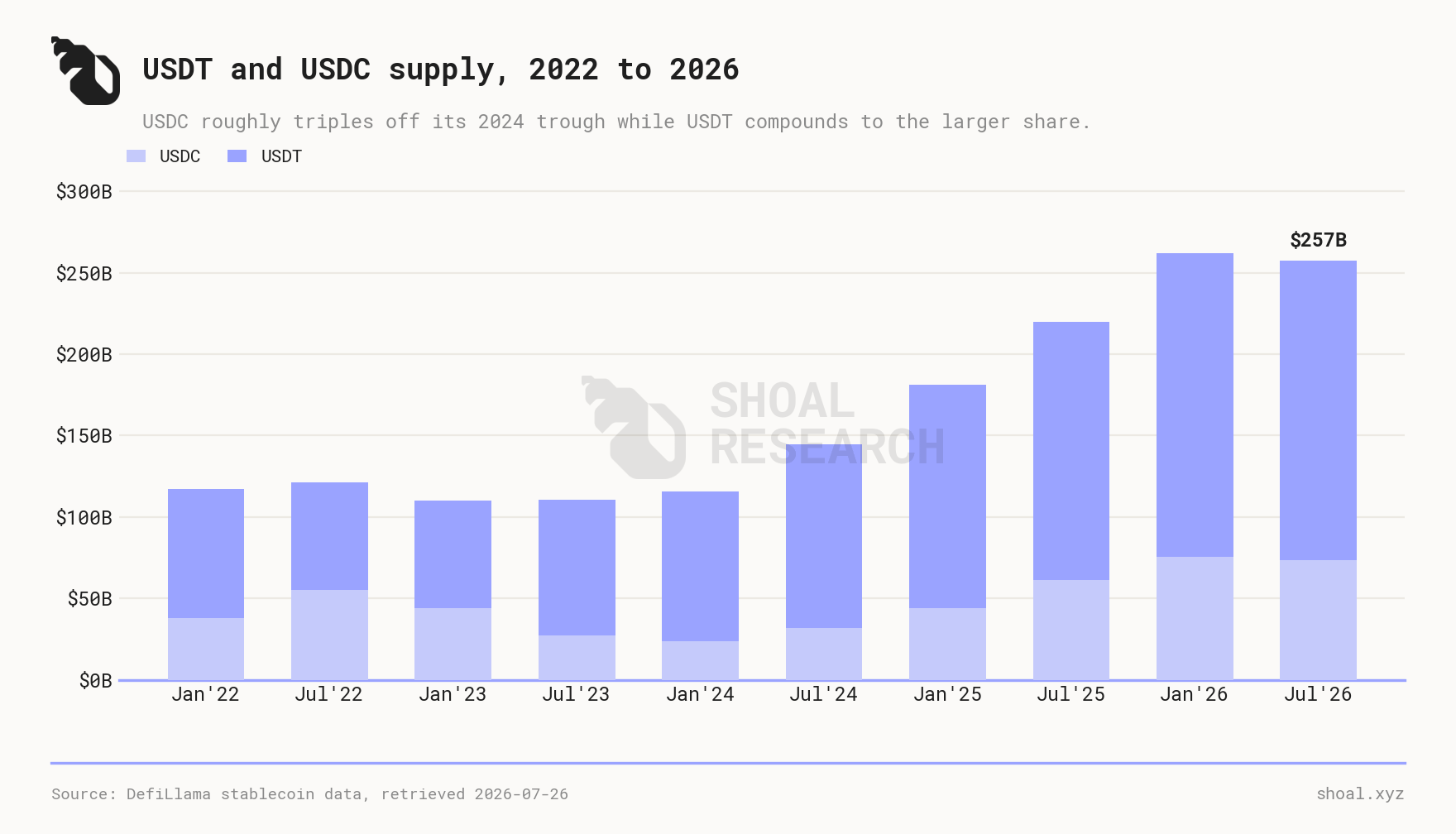
But an agent breaks the correlation that makes supply the headline metric in the first place, because they hold a balance to spend. A human treats a stablecoin balance as a place for money to sit, whether as savings, trading collateral, or dry powder waiting on an opportunity, so more holding translates directly into more supply. An agent's wallet is funded for a different purpose, holding just enough to cover the workflows it needs to execute, drawing that balance down through dozens or hundreds of payments, and getting topped up again as it runs. The same dollar in an agent wallet might move ten times in the period a human-held dollar moves once, so a modest amount of supply can generate enormous volume and transaction count. Agent-driven usage is best reflected by metrics that measure movement rather than metrics that measure resting balances.
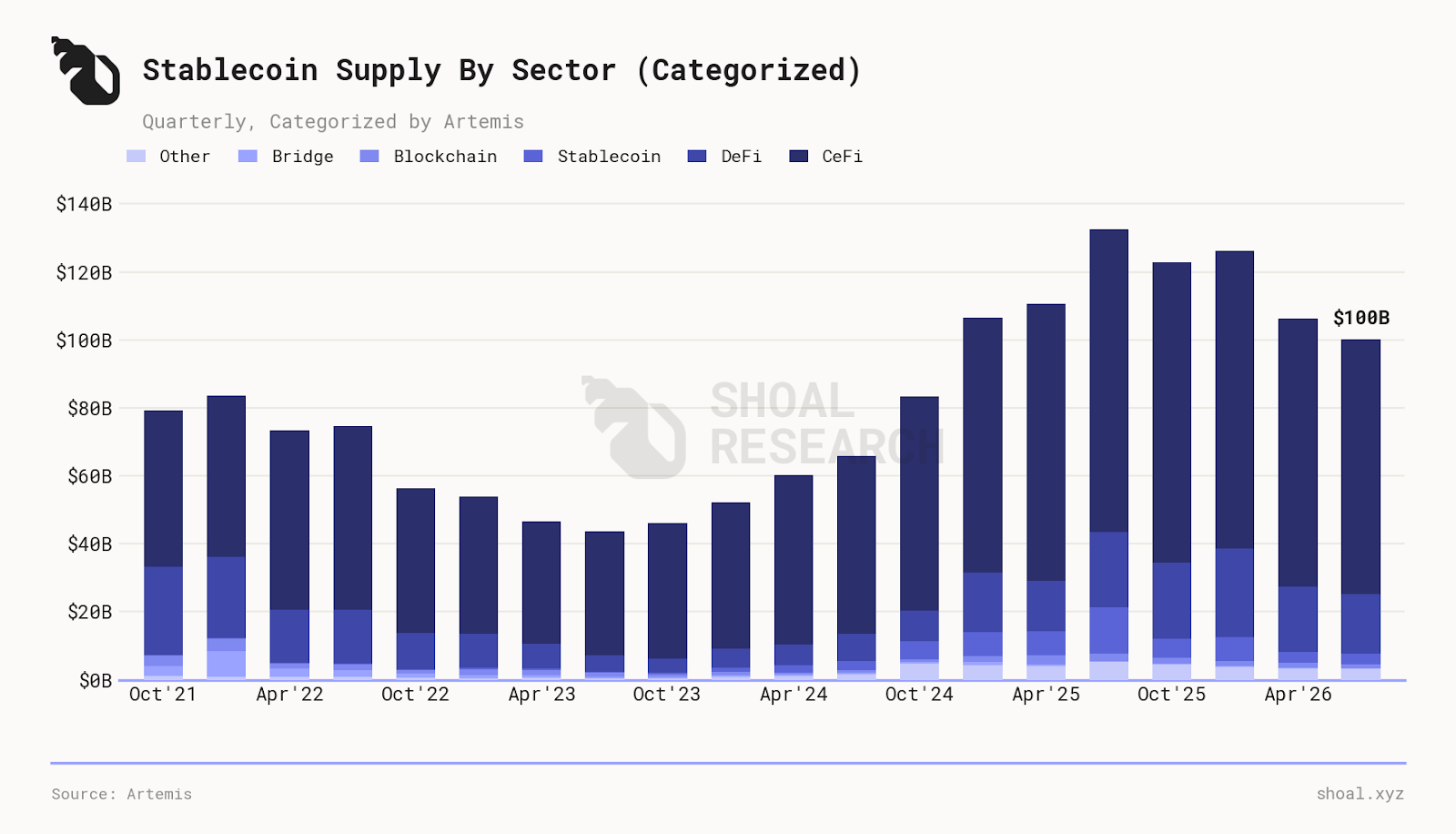
This point becomes more evident when observing stablecoin supply by sector. Of the supply Artemis attributes to a sector, CeFi, meaning centralized exchanges and the exchange-like products built around them, dominates near $75B, DeFi accounts for roughly $25B, and payments are negligible. The overwhelming majority of attributable stablecoin supply sits as exchange collateral, trading margin, and DeFi liquidity, contexts where the asset is parked to earn rather than being spent, so the market's largest supply pools tell us almost nothing about which asset agents will actually transact in.
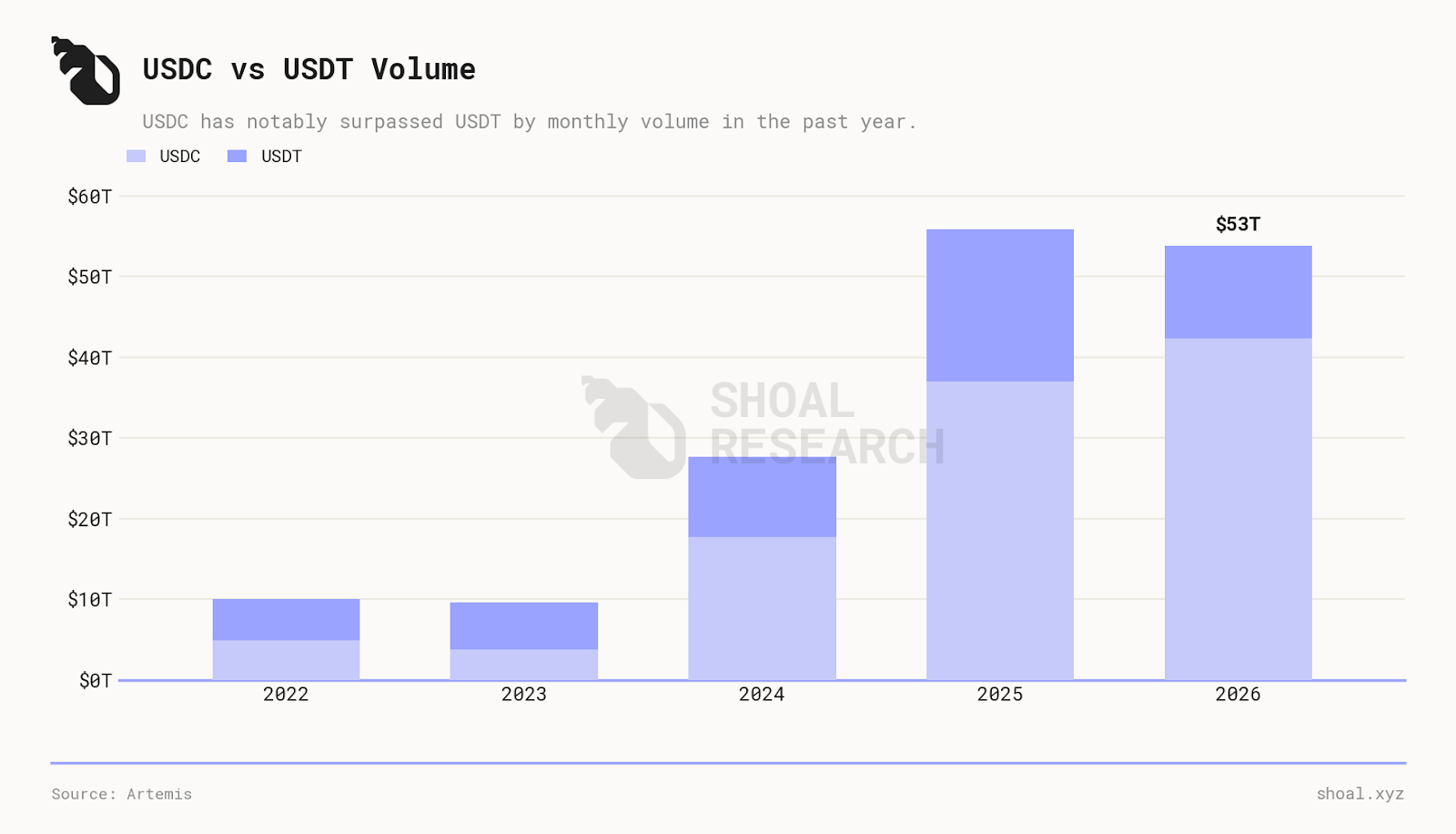
Agent activity largely appears in stablecoin volume, as each workflow an agent runs (e.g. paying for an API call, purchasing data, settling with another agent) moves dollars, and those transfers accumulate into volume whether or not circulating supply grows.
Transaction count also maps well to agent behavior. An agent's payment activity is a series of discrete payments, one per API call, per data query, per task settled, so the number of transactions tracks the number of things agents actually did, independent of what any of them cost. And the denominations involved make this distinction matter. Cloudflare CEO Matthew Prince recently noted that non-human internet traffic is projected to surpass human traffic somewhere in 2027, and that the micropayments powering much of it will each run fractions of a penny. A billion sub-cent payments amount to little in dollar terms, so at these denominations transaction count measures activity that volume does not capture.
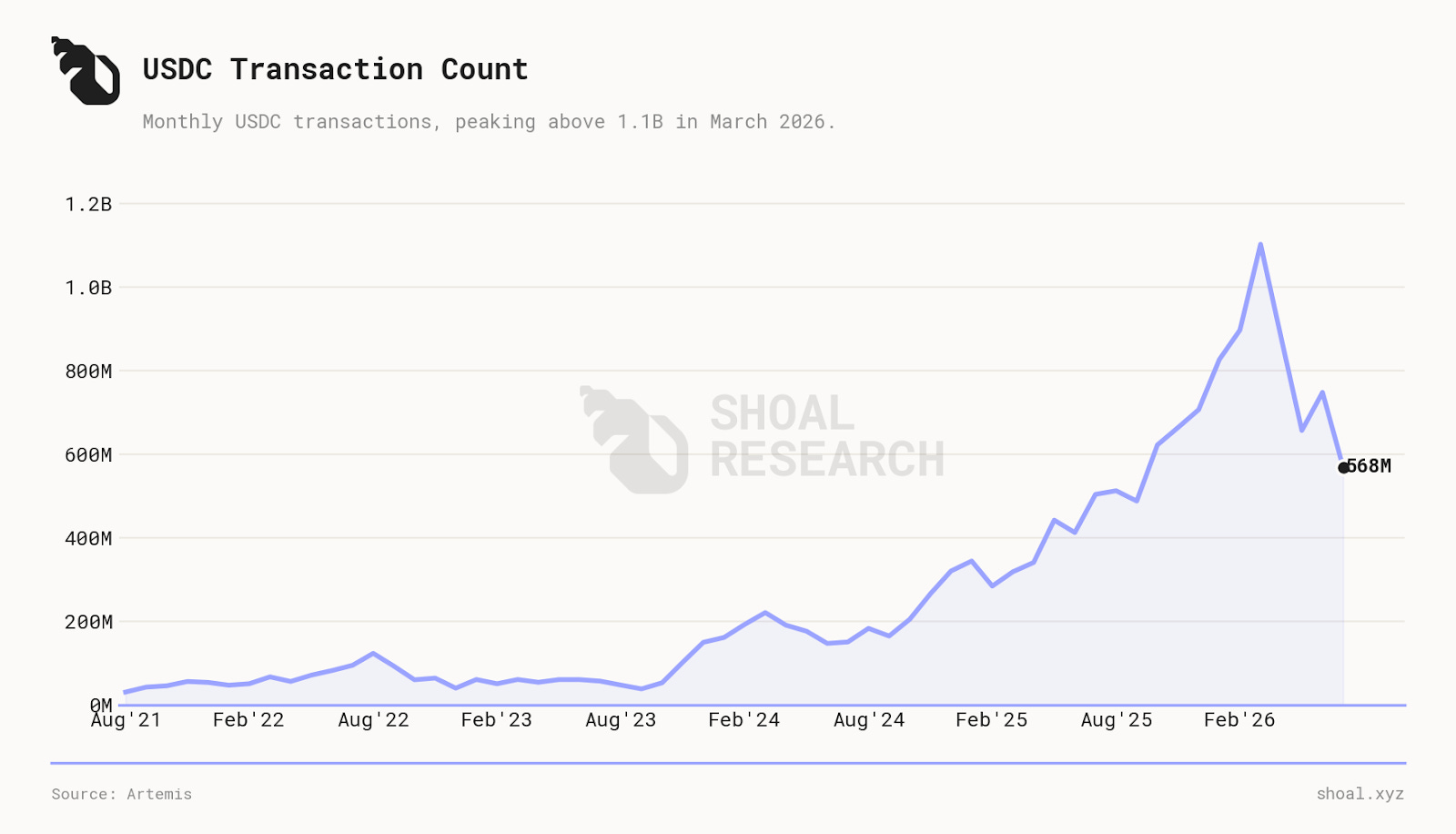
Across stablecoin metrics that capture movement, USDC has grown fastest, taking the majority of combined USDC and USDT volume while its monthly transaction count has multiplied roughly 5x in two years, all with a supply less than half of USDT's size.
Which leads us to USDC’s issuer: Circle.
Coming Full Circle
Circle Internet Group, Inc. is a regulated financial technology company whose core product is USDC, alongside EURC, a euro-denominated stablecoin, and USYC, a tokenized money market fund used for institutional collateral and trading. Issuance is the base of the business, and Circle has built the rest of its payments stack on top of it. The lowest layers handle the asset itself, with Circle Mint and xReserve supporting institutional minting and redemption; the Cross-Chain Transfer Protocol (CCTP) burns USDC on one chain the user specifies and mints it on another; and Gateway builds on top of CCTP to enable a single USDC deposit to function as one balance across any supported chain. Above them sits the Circle Payments Network (CPN) which connects banks, PSPs, and fintechs through a single API so counterparties can transact in fiat while Circle handles the stablecoin conversion, compliance, and settlement behind the scenes. Circle also launched Arc, an in-house L1 that uses USDC as the native gas token. Arc’s public mainnet now scheduled for September 2026, set to go live with a curated set of global financial institutions including BlackRock, The Depository Trust & Clearing Corporation (DTCC), Galaxy, Global Payments, ICE, Mastercard, MoneyGram, SBI Group, Standard Chartered, Sumitomo Corporation, and Visa.
Yet for all its expansion up the payments stack, Circle was and remains a reserve-income business. In Q2 2026, Circle’s reserve income ($668m) accounted for 95% of the $701m in total revenue and reserve income. Circle's growth is therefore tied to whatever expands USDC held and used, and agents expand both, holding funded balances that add to the supply Circle earns on, and transacting continuously across USDC rails.
Circle In The Agentic Economy
USDC is already an active part of the early but growing agentic payments space. The most telling example is the x402 protocol, which enables agents to pay for web resources within a standard HTTP cycle. Though x402 now supports multiple payment methods, USDC was the initial payment rail and still settles 99% of x402 transaction volume, a dominant position Circle captured before it had actually built any infrastructure specifically for agents.
In May 2026, Circle took a major step towards verticalization with the launch of the Circle Agent Stack, introducing the infrastructure layers designed to build USDC into a full-stack platform for agentic payments.
The Circle Agent Stack
The Circle Agent Stack is a suite of five components (Nanopayments, Agent Wallets, the Circle CLI, Agent Marketplace, and Circle Skills) that’s designed to provide AI agents with controlled access to USDC, enabling them to hold funds, discover services, and transact programmatically with external services and with one another.
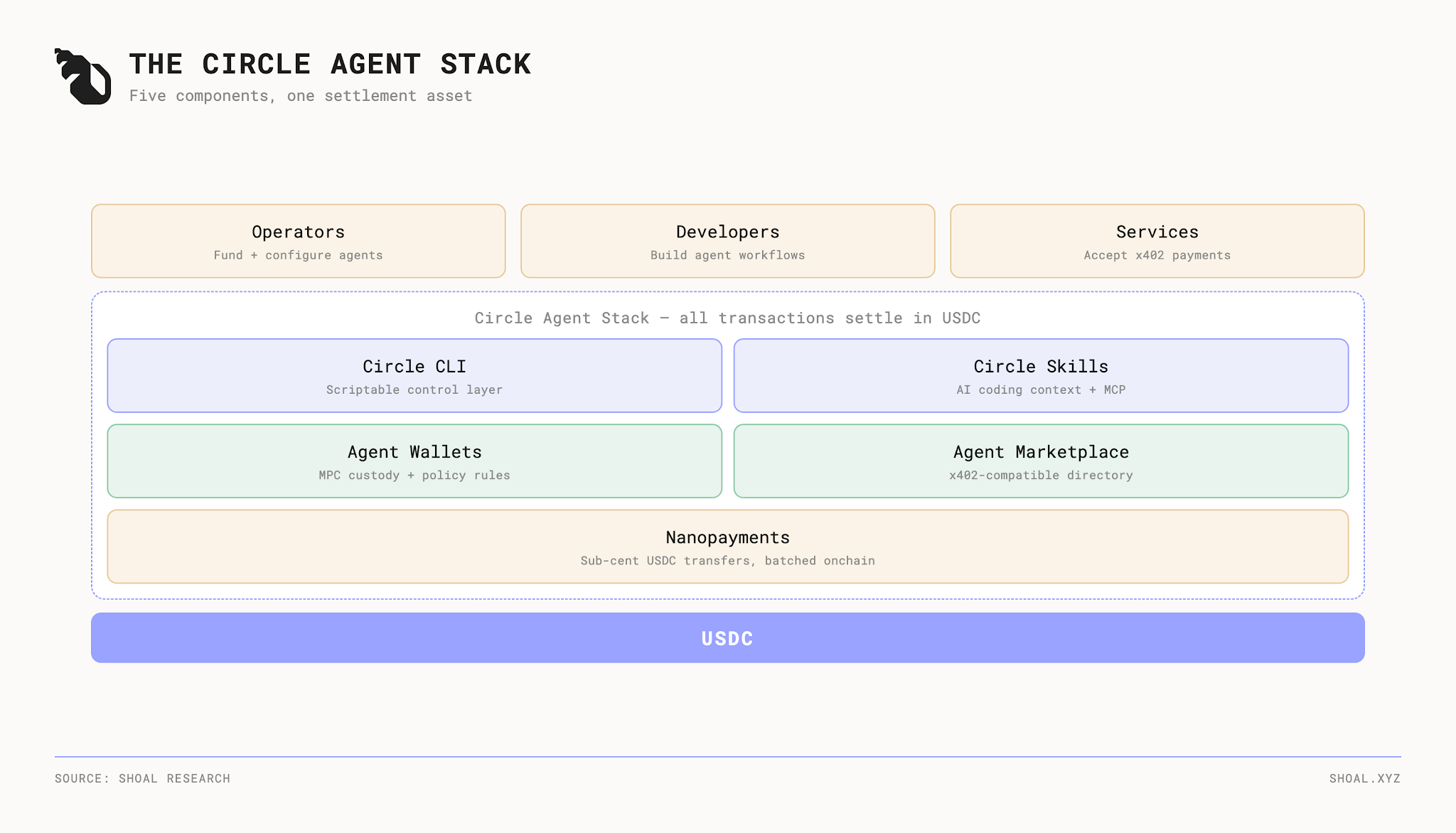
The stack is both chain and protocol-agnostic by design, extending Circle's existing suite of wallets, cross-chain infrastructure, and settlement rails to agent-driven programmatic transaction flows.
Nanopayments
Nanopayments are ultra-small transfers of fractional-cent amounts, which can be as little as $0.000001. The idea is not new, but every prior attempt, from credit card networks to Bitcoin's Lightning Network, failed for the same structural reason: the cost of clearing a payment exceeded the payment itself.
Circle Nanopayments move the cost off the individual transfer, meaning gas is paid once, when the buyer funds a gateway balance, and every payment after that is an offchain signature with zero cost to produce. Nanopayments are denominated in a stable asset (USDC) and separate verification from settlement, allowing a seller to be credited and carry out delivery immediately while final settlement is batched later. Built on Circle Gateway and implementing the x402 v2 standard as a payment option, Nanopayments plug into the request-response flow HTTP already runs.
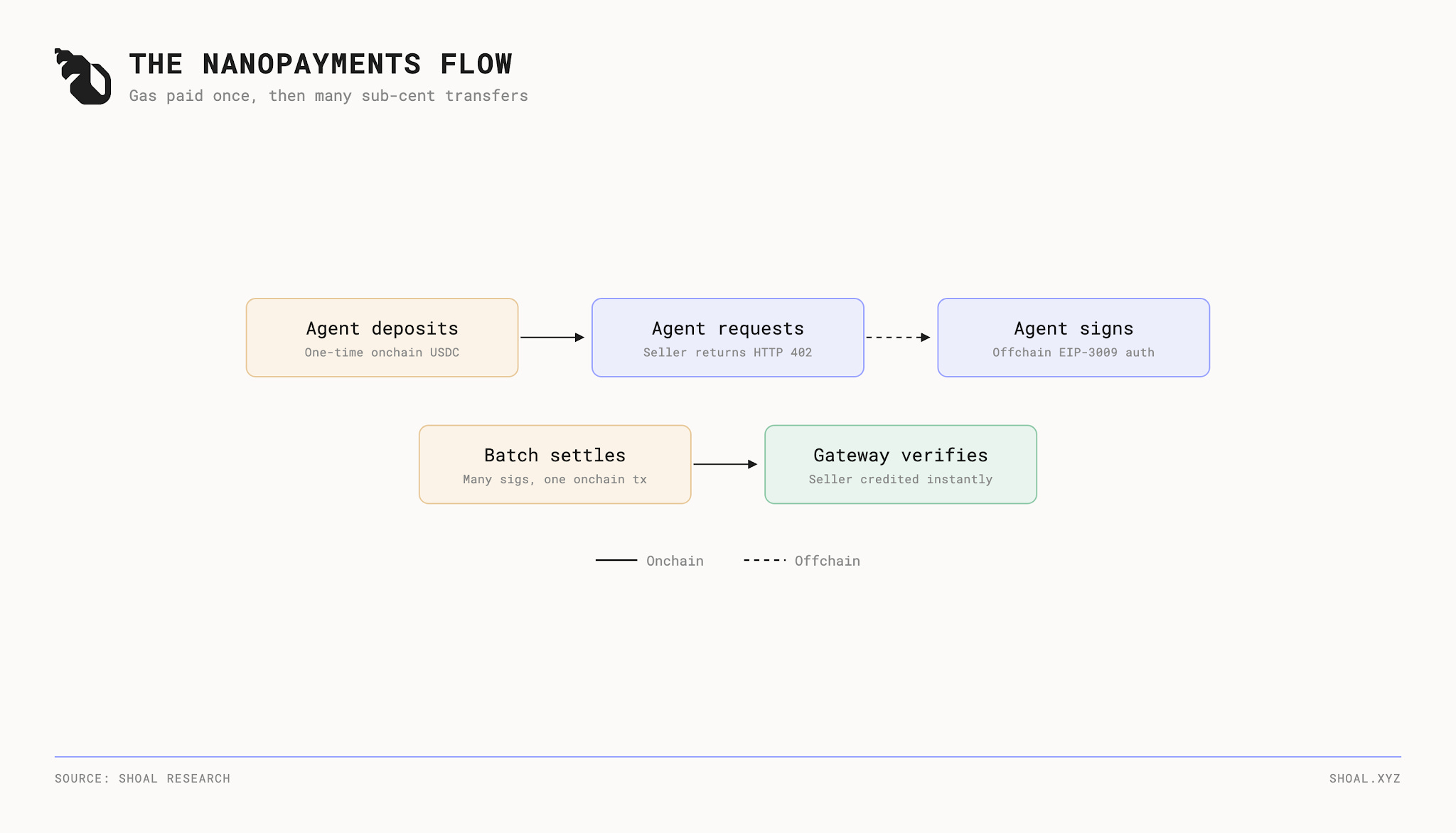
The buyer makes a one-time onchain deposit of USDC into the Gateway smart contract, establishing a balance. When an agent requests a paid resource, the seller responds with a 402 status code carrying the payment details. The agent signs an EIP-3009 message authorizing the Gateway contract to move the specified amount from its balance to the seller. The seller submits that signed authorization to Gateway, which verifies it, locks the funds, and credits the seller immediately without waiting for settlement.
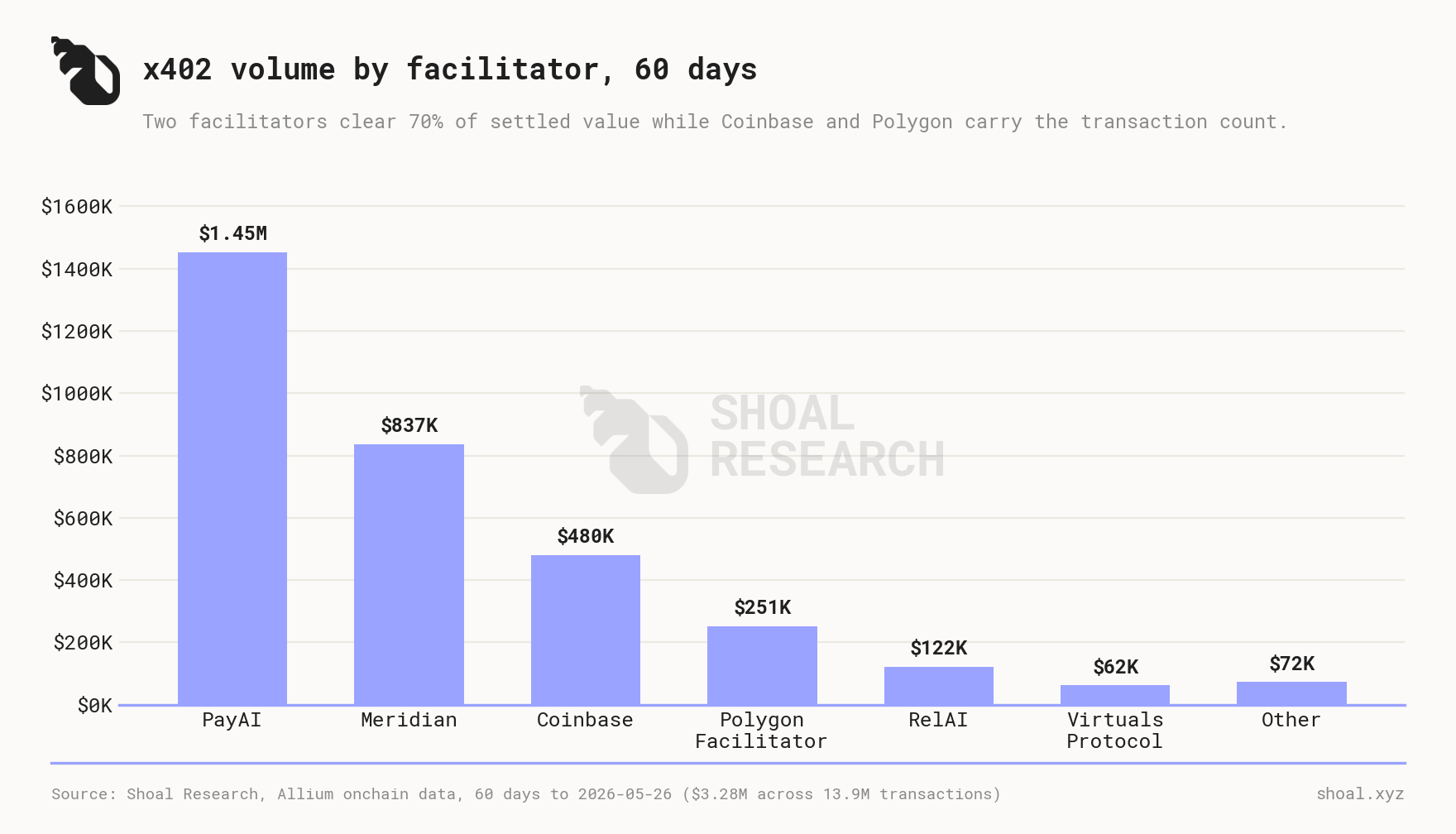
This design also lets Circle eliminate a key structural dependency. x402 deals with payment authorization and settlement, two separate steps. A seller can integrate its own onchain infrastructure to handle them, or use a facilitator to do it instead. In practice most sellers use a facilitator, and the standard integration defaults to Coinbase's. By running both steps through Gateway, Circle is its own facilitator. A seller simply swaps the facilitator client in its x402 middleware for Circle's BatchFacilitatorClient and points settlement at Gateway, and from there verification and settlement run through Circle.
Batching is what makes running its own facilitator worthwhile for Circle. A per-payment facilitator settles each transaction onchain as it clears, which at sub-cent amounts costs more than the payment is worth. Gateway instead collects pending authorizations, computes the net balance changes across all participants, and submits a single onchain transaction applying them in bulk, bringing per-transfer cost down to as little as $0.000001.
Gateway runs inside an AWS Nitro Enclave, an isolated hardware environment, which verifies every authorization before including it in a batch, while the Gateway smart contract verifies the enclave’s signature before executing. This helps ensure only verified batches can be routed onchain for settlement.
Agent Wallets
Agent Wallets are permissionless, policy-controlled wallets designed to enable agents to hold, send, and manage funds within predefined parameters and spending guardrails. Whereas a standard crypto wallet's private key authorizes spending the full balance, an Agent Wallet is built on Circle's user-controlled wallets with 2-of-2 MPC key management, splitting the key so the agent never holds it and the operator keeps custody. A policy layer checks every transaction against preset rules and screens it against sanctions controls prior to execution.
Mechanically, operators configure policies at the wallet level before an agent begins operating, setting time-bound USDC spending limits, allowlists and blocklists for specific wallet and contract addresses, and permitted transaction types. Policies are enforced at the wallet layer, meaning transactions are checked against predefined rules before execution, keeping agents within the boundaries their operators set. Agent Wallets support USDC and ERC-20 tokens across supported chains, and once funded, agents can begin transacting immediately with no manual approval flow required.
Circle CLI
The Circle CLI is a text-based control layer that lets developers and AI agents build on top of Circle's entire platform, with a focus on wallet creation, payment execution, and policy management. For agents specifically, the CLI provides a single scriptable interface that can be operated directly.
With the CLI, an agent can access Circle Wallets, CCTP, and Gateway to create wallets, define spending policies, discover services, and trigger transactions through precise commands. The CLI is framework-agnostic, compatible with harnesses like Claude Code, Cursor, Codex, and any custom agent framework, meaning it integrates into existing developer workflows without requiring a new environment or toolchain.
Agent Marketplace
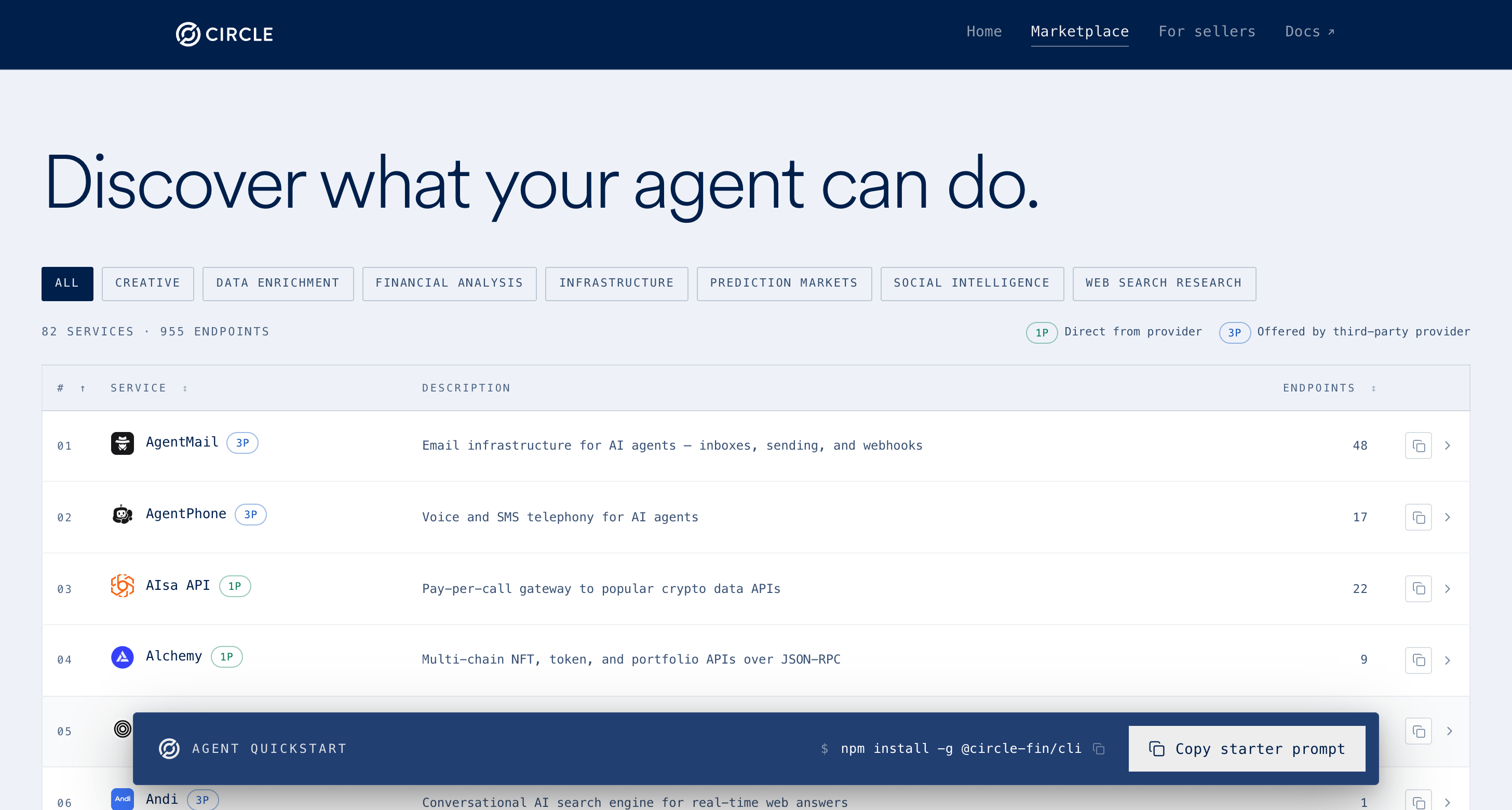
Agent Marketplace is a directory of agentic services that both humans and AI agents can browse, assess, and integrate with, allowing agents to discover and pay for services programmatically. Services listed are x402-compatible, meaning agents can pay per request without managing API keys, subscription tiers, or billing cycles. The payment is embedded in the HTTP request itself, authorized by the agent's wallet, and settled via Nanopayments in the background.
Circle Skills
Circle Skills is a set of open-source files that provide AI coding assistants with structured context about Circle's entire platform, covering API surface, authentication patterns, error handling, and best practices. When a developer asks an AI coding tool to set up a USDC payment flow, the assistant already has Circle's integration patterns loaded without the developer needing to leave their environment. Circle Skills work standalone and are complemented by Circle's MCP server, which handles SDK details that change frequently between versions.
Altogether, the five components of Circle's Agent Stack give agents a sub-cent payment rail in Nanopayments, a custody-and-policy wallet layer in Agent Wallets, a discovery layer in Agent Marketplace, and developer tooling in the CLI and Skills to connect them.
The Circle Thesis
Circle’s position for agent payments boils down to three key catalysts:
USDC is a durable asset that is gaining ground on the metrics that matter most for agents. USDC has been around since 2018 and has endured a number of stress tests since then. It has operated since 2018 and held its peg through the Terra/LUNA and FTX collapses. By Circle's Q2 2026 reporting, USDC onchain transaction volume reached $14.8 trillion for the quarter, up 151% year over year, and per Artemis, USDC has taken the majority of combined USDC and USDT transfer volume while growing its monthly transaction count roughly 5x in two years, all on a float less than half of USDT's. And USDC still settles 99% of x402 payment volume, even as the protocol has added support for other assets including USDT.
Circle’s regulatory moat lowers the compliance burden for developers. Anyone deploying agents that spend money runs into financial regulation, and it is one of the hardest parts of getting them live, because the rules for what autonomous software can do on a user's behalf are still unsettled. Building on USDC hands most of that to Circle. Transactions settle through Circle's licensed entities, so money-transmission compliance sits with the issuer, not the builder. AML and KYC screening runs at the protocol level, so payments are checked by default. And Circle's licenses make USDC a recognized payment instrument in the US and EU, so a builder operates under Circle's regulatory umbrella rather than securing its own in every country an agent touches.
Agents make Circle money in new ways, and each one strengthens the others. An agent costs almost nothing to run, so a company can run thousands as easily as one, and each one feeds Circle in a way human payments never did. To work at all, an agent has to hold a funded balance, since a payment from an empty wallet fails and stalls the task, so operators keep their agents topped up for as long as they run. Those balances are backed by real dollars Circle holds in short-term government debt and keeps the interest on, which is where 95% of its revenue comes from today, so every agent deployed adds to the balance Circle earns on and leaves it there. Agents also transact constantly, thousands of times the rate a person would, and Circle's fee lines, subscriptions, services, and per-transaction revenue, scale with that activity, though they remain small next to interest for now. And once a company wires its agents to USDC, with funded wallets, spending rules, and integrations built around it, moving off means rebuilding all of it. In theory, this lays the foundation for compounding growth, since more agents grow the balance Circle earns on, more activity makes USDC the default developers build for, and that default pulls in more agents to USDC and Circle's stack.
Taken together, Circle has positioned itself for agent payments by building on the position it already held, a proven asset, compliance a builder inherits, and economics that compound as USDC circulates. The bet is that AI agents are the demand that turns that position from strong to decisive. They hold funded balances, pay constantly in tiny amounts, and need a rail that clears for fractions of a cent, which is what USDC already does best. As of mid-2026, Circle is the only stablecoin issuer to have verticalized a cohesive agent payments stack around its own asset.
Key Risks & Open Questions
However, no bet is without its risks. First, it helps to address the broader risk that agent payments, agentic commerce are a marketing trend and by no means a structural shift in the broader payments stack. By glancing at the data at a surface level, it certainly appears that way.
Most of the skepticism targets the timeline, the claim that agent payments are happening at scale today rather than in their earliest experimental phase. The evidence for that skepticism is real. The strongest supporting point is that the majority of existing x402 volume generated over a several-month period after which total volumes continuously declined. Even more telling to this point, much of that volume was determined to be largely inorganic. Artemis runs a wash-trading filter to identify organic activity, and found that roughly half of x402 transactions were gamified in some way. Through late 2025, x402 activity was dominated by speculation. Per Artemis, the speculative share of x402 volume rose from under 6% in October 2025 to 59% in November and 67% in December, much of it the PING pay-to-mint token. For a brief period of time, using the x402 protocol was a way to farm a memecoin rather than a genuine record of agents using the payment rail for real workflows.
The speculative share has since declined: 51% in January 2026, then a 25% to 40% range in the months after, averaging 33% over the trailing 30 days. Total volume also fell from its late-2025 peak over the same period. So the protocol is processing less volume than at the spike, and a smaller share of it is speculative.
The counter is frustratingly simple: we are still early. Inorganic x402 volume, while not indicative of a structural shift in payments in any way, is not indicative of the future adoption of the protocol, nor agent payments as a whole, either.
History has taught us that a speculative blowoff in a nascent market is not enough to evaluate its long-term legitimacy. Consider the early days of e-commerce. In 2000, online shopping was about 3.9% of US retail sales, and the sector had just lived through a mania that priced it as the imminent future. When the dot-com bubble burst, most companies, which were propped up by hype and speculation, died. Pets.com folded nine months after its IPO, Webvan lost over $800 million, eToys went bankrupt twenty months after going public. The crash looked, at the time, like a verdict on the whole idea. But in reality, the behavior kept compounding through the wreckage, the survivors (Amazon chief among them, down roughly 90% at the bottom) built the infrastructure the next decade ran on, and e-commerce is about 19% of US retail today. Agent payments follow the same pattern. The x402 data shows a speculative spike that has since drained, while more recent data shows that the protocol is in genuine and growing use, though it does not in any way suggest that agent payments have already arrived at scale.
Another broad risk, which applies to every stablecoin issuer, not just Circle: agents may settle on cards rather than stablecoins. Card networks have moved quickly into agent payments, and for consumer purchases where a human wants recourse, the familiar card rail may simply be the better fit. Whether cards or stablecoins win which flows is unresolved; we touch more on this in the open questions below
Structural Risk: Velocity Diminishes The Float Business
Circle earns net interest income on the reserves backing circulating USDC, a business model sensitive to the velocity of money. Standard Chartered estimates stablecoin velocity has reached roughly six times monthly turnover, about double the rate of two years earlier, and framed the implication directly, if velocity stays constant, rising transaction demand pulls more coins into circulation, but if velocity rises, the same demand is met with fewer coins outstanding. The bank attributes the surge largely to USDC itself, concentrated on Solana and Base and tied to TradFi displacement and early AI-agent payments, while USDT velocity has stayed flat in its emerging-market savings role.
Agent activity pushes in that same direction, since sub-cent nanopayments, streaming usage, and pay-per-crawl flows turn USDC from a balance that sits into a balance that cycles, so higher utility can coexist with a flatter reserve base, compressing per-dollar earnings.
This tension has not escaped Circle, and it makes Arc's role as a structural hedge clearer. By making USDC the native gas token on its own chain, Circle captures value per transaction rather than per dollar held, building a revenue line that scales with velocity directly.
Competitive Risks
Circle faces a multi-pronged competitive landscape.
Stripe has assembled a closed-loop stablecoin stack by acquisition; it bought Bridge, a stablecoin orchestration and on/offramp provider, and Privy, an embedded wallet product with over 75 million accounts. Stripe also jointly incubated and launched Tempo, a payments-focused L1, and co-authored the Machine Payments Protocol (MPP), an open standard for one-shot, recurring, and streaming API-native payments designed for agents. As a result, Stripe can take fiat in, settle on its own chain, and pay a merchant out, with the merchant never touching stablecoins or crypto. Circle's counter is the structural independence of its stack, which makes it the better choice for developers wary of vendor lock-in. Where Stripe is a proprietary end-to-end ecosystem, Circle is a protocol-agnostic issuer whose asset settles across chains it does not own. A closed loop only clears when both counterparties sit inside it, while a neutral asset clears between any two parties regardless of the stack either one runs. For agent-to-agent and agent-to-service payments, that reach is the more valuable property, and it is the same dynamic that made USDC the default on x402 before Circle had built anything specific for agents.
Stripe and Tempo's MPP does settle in USDC.e, a bridged USDC-backed stablecoin, on Tempo, Base, or Solana, so in one sense it is another rail carrying Circle's asset. But unlike x402, where USDC settles nearly all volume, MPP is deliberately payment-method-agnostic, able to settle the same charge in a stablecoin, on a Visa or Mastercard card, in Bitcoin over Lightning, or in any method a developer plugs in, and this neutrality is what makes MPP particularly competitive for Circle. MPP treats USDC as one option among many rather than the default; it can route an agent payment around stablecoins entirely onto a card, and Tempo, Stripe's own chain, settles all stablecoin payments. MPP doesn't exclude USDC so much as commoditize it, turning Circle's core asset into interchangeable settlement under Stripe's orchestration.
Coinbase is simultaneously Circle's largest distributor (~$19B USDC) and its largest structural risk. Under the current revenue-sharing agreement, Coinbase receives 100% of reserve income on USDC held on its platform, and 50% on USDC held elsewhere. In FY2025, Circle retained $1.083B of $2.747B in total revenue and reserve income after distribution, transaction, and other costs, meaning the majority of gross monetization was paid out through the distribution layer, principally to Coinbase, a partner that neither issues USDC nor manages its reserves. Coinbase's share of average USDC balances rose from roughly 5% in early 2023 to about 24% by the end of 2025, growing through the 2023 contraction even as total balances fell, and because the agreement pays Coinbase full reserve income on-platform and half of the rest, by Q4 2025 Coinbase captured the economics on roughly 62% of all average USDC while holding under a quarter of it.
The deeper risk with Coinbase is positional; Coinbase created the x402 protocol and owns AgentKit, CDP wallets, and Base, and it runs the protocol's default facilitator, the service that verifies and settles x402 payments on the seller's behalf. That facilitator is the one most USDC settlement currently routes through, so even on its own asset, Circle does not own the point where agent payments clear. If agent workflows standardize on this stack, Circle is relegated to backend issuance while Coinbase owns both the developer relationship and the settlement path.
The facilitator role is where Circle pushes back most directly, and it makes another case for the Agent Stack. Through Gateway, Circle now runs its own facilitator for batched USDC flows, and switching to it is a server-side change rather than a re-architecture. It does not displace Coinbase as the network default, but it gives Circle a settlement path it controls around its own asset, with batched economics a per-payment facilitator cannot match at sub-cent denominations.
Tether was, is, and will be Circle’s biggest competitor. USDT circulates around $183B, and dominates on Tron and in emerging-market cross-border flows. The issuer reported strong Q2 numbers, including over $1.5B in net profit. Tether has made an active effort to integrate its stablecoin into AI-native environments, but importantly its AI strategy is architecturally different from Circle’s: the Wallet Development Kit and the QVAC local-first AI SDK target sovereign agents that run on-device and offline, bypassing the banking-API dependencies that Circle and Stripe rely on, and its self-custodial wallet pairs USDT, USAT, BTC, and gold with on-device AI. However, there are chinks in Tether’s armor, the biggest ones being regulatory hurdles, that could outweigh a lot of technical development progress. USDT is not MiCA-compliant, with major EU exchanges having delisted it as MiCA took effect. Tether has aimed to concentrate in non-MiCA, non-US markets while launching a separate US-compliant stablecoin, USAT, launched in January 2026 through Anchorage Digital, a federally chartered US crypto bank, though USAT’s total circulating supply ($185m) is notably
Lastly, the set of potential stablecoin issuers is only widening, which threatens USDC's default status more than any single rival. Enterprises can launch their own coins and stacks to avoid dependence on Circle. Polygon announced its "Open Money Stack" on January 8, 2026, repositioning as payments infrastructure, PayPal launched PYUSD years ago, and Western Union launched USDPT, a regulated dollar stablecoin issued through Anchorage Digital on Solana, in May 2026. The counterclaim here is that though launching a branded coin has become much easier than in years prior, it is almost always done through a regulated issuance-as-a-service partner rather than built in-house. Few enterprises want to run reserve management, monthly attestations, and money-transmission compliance themselves. A branded coin also starts with no liquidity, no integrations, and no acceptance, so the binding constraint is distribution and liquidity. Working with an established stablecoin issuer is, by default, the easier path.
Regulatory Risk
No US or EU regulation directly targets autonomous agent payments as of mid-2026; existing AML, KYC, and Bank Secrecy Act obligations reach them through the issuer. The GENIUS Act, signed July 18, 2025, is a net positive for Circle. It requires 1:1 backing in cash and Treasuries, monthly reserve disclosures, bars non-permitted issuers from the US market, classifies payment stablecoins as neither securities nor commodities, and prohibits issuers from paying yield or interest to holders, a provision that legitimizes Circle's existing model while foreclosing yield-bearing competitors. Broader market structure in the US is still being worked on via the CLARITY Act, which passed the House 294-134 on July 17, 2025, cleared the Senate Banking Committee in May 2026, but has yet to receive a full Senate vote. Overseas in the EU, MiCA has governed stablecoins since 2024. Circle's French entity holds a MiCA e-money license and EURC is compliant, while USDT is not. Circle's regulatory moat, money-transmitter licenses across US states, a NY BitLicense, FinCEN registration, a Singapore MPI license, and regulated entities in Japan, the UAE, and Hong Kong, is strong in today's environment. The open risk is forward-looking, since a future AI-specific payment framework could impose obligations the issuer layer, Circle included, does not yet satisfy.
Open Questions
Arc and Its Growth
Arc is the clearest lever for Circles velocity problem, and its economics are unproven. By using USDC as the native gas token, Arc lets Circle capture value per transaction rather than per dollar held. What remains unknown is adoption and pricing. If Circle subsidizes gas or activity to bootstrap the network, it trades near-term fee capture for volume, and the velocity-capture thesis only pays off once unsubsidized fee revenue scales. Arc's first-year fee economics after mainnet will show whether it decouples revenue from float or runs as a strategic cost center.
Which rails win agentic payments?
Nothing yet implies that Circle's Agent Stack becomes the default rail for agent payments. Circle is not the only one building here, and the most complete rival is Coinbase, which created x402, runs the facilitator most x402 payments settle through, and owns AgentKit, the CDP wallets, and Base, the chain where most x402 activity happens. Stripe has its own chain, Tempo, and the Machine Payments Protocol. AWS's AgentCore Payments routes through x402 on Coinbase's Base rather than through Circle.
Circle's position here is a unique one. Because its stack is x402-compatible rather than proprietary, it can win share inside the standard without having to displace it, and USDC already settles nearly all x402 volume. But the facilitator and developer stack belong to Coinbase, so even when a payment settles in USDC, the developer relationship and the settlement path frequently run through Coinbase's rails rather than Circle's. The question then becomes whether developers adopt Circle's wallet-and-Nanopayments bundle directly or simply use USDC as the settlement asset under another orchestrator.
Stablecoins or Cards?
A related open question is whether agents simply use cards instead of stablecoins, and what Circle does in that case. Mastercard launched Agent Pay in April 2025 and completed its US rollout by November, built on what it calls Agentic Tokens, a card credential bound to a specific agent with per-session and per-merchant spending limits. Visa shipped Intelligent Commerce, which lets an agent present a verifiable credential a merchant checks before accepting payment. Stripe's Shared Payment Tokens, already used by Etsy and Urban Outfitters' parent company URBN, let an agent pay with a customer's existing card without exposing the card number.
The likely outcome is a world where there's some mesh between stablecoins and card network rails because they serve different purposes in domestic and global remittance.
The case for cards is pretty straightforward: a developer building a consumer shopping agent already understands cards, reaches almost any merchant through them, and gets chargeback protection a stablecoin transfer does not provide. But cards are built for buying from merchants, and a whole class of agent payments has no merchant on the other side, agents paying other agents, paying for API calls, data, and compute, settling across borders, all more efficient on stablecoin rails. The more likely outcome is that the two rails get built out in parallel, serving different segments with different needs, and which rail wins remains open.
AI Hardware
AI hardware like physical agents and edge devices is an adjacent demand source that could accelerate or bypass the Agent Stack. Circle's demonstration with OpenMind, in which an autonomous robot recharged itself by paying in USDC through Nanopayments, is an early instance of a payment loop initiated by hardware. The open question is which architecture succeeds, since Circle's Agent Stack assumes cloud-connected agents that can reach its APIs, while Tether's QVAC SDK is a bet that the hardware layer favors local, bank-API-independent designs.
The Role of On-Offramps
Agents are funded once and then transact thousands of times, so the ramp-to-transaction ratio diminishes, but ramps do not become less important. Custody and fiat conversion concentrate the majority of a payment system's operational risk, and whoever owns the ramp owns the edge where the workflow meets the real world. Circle already has the CPN for this. The competitive question is whether CPN's institutional, bank-facing design wins the same ground Stripe's Bridge covers at the developer-API level, since the ramp an operator reaches for shapes which settlement asset its agents default to.
Privacy features
Privacy will be a critical factor in the adoption of stablecoin rails, particularly for institutions and enterprises. USDC is fully public on every chain today. Arc offers opt-in privacy with sub-second finality and quantum-resistant signatures at mainnet, but relying on Arc alone leaves USDC on every other chain transparent, which is why we believe the stronger move is for Circle to launch its own privacy layer for USDC across all supported chains.
Taken together, the risks and open questions come down to the same underlying tension: Circle controls the asset, but not yet all the layers built on top of it. The structural risk is that velocity rises faster than supply, thinning the float Circle's revenue depends on. The competitive risk is that someone else owns the layer where agent payments actually clear, Coinbase through the x402 facilitator and its developer stack, Stripe through a multi-rail protocol that treats USDC as one option among many, Tether and a widening field of issuers competing for the same default status. The open questions are the flip side of the same point, whether agents settle on Circle's rails or on cards, whether developers build on Circle's stack or merely use USDC as settlement under another orchestrator, whether the ramp, the hardware layer, and the privacy layer end up belonging to Circle or to a competitor. Each brings us back to one main question, whether Circle owns the layers agents actually use.
Closing Thoughts
The stablecoin issuer is one of the most unique business models in payments today, because it is the only business that actually owns the asset being moved around. A card network or payment processor moves money that belongs to banks and cardholders, and charges a fee for handling it. A stablecoin issuer takes custody of deposited dollars, provides a digital equivalent to the depositor, parks the real dollars somewhere, like short-dated Treasuries, and keeps the interest as well. This wasn’t always a lucrative position; for most of stablecoins' history the asset sat idle as exchange collateral and trading margin, traders held stablecoins to post against leveraged positions and to move between trades without returning to the banking system, and stablecoins existed to sit idle mostly (CeFi does still account for roughly $75B of attributable supply and DeFi another $25B, while payments remain negligible). What stablecoin reserves earn depends largely on the Federal Reserve's policy rate (since they are held in short-term US Treasuries), and that rate was effectively zero from March 2020 until the Fed began raising it in March 2022, meaning issuers’ reserves earned relatively little through the years stablecoin supply was growing fastest. And the lack of regulatory clarity had kept institutional payment volume away, as up until the passing of the GENIUS ACT in July 2025, it was unsettled whether stablecoins were securities, which agency supervised the issuers, and whether banks could hold them. Another major hurdle on the regulatory side that remains is the to-be-passed CLARITY ACT, but time will tell.
Agents are the next source of growth for the stablecoin business, and a structurally larger one than anything that came before, because they feed both sides of the issuer's economics at once, float and movement. On float, an agent cannot pay from an empty wallet. Payments execute against whatever balance the wallet holds at the moment a condition triggers, and a transaction that fails for insufficient funds stalls the entire workflow it was part of. Operators therefore fund wallets in advance and replenish them periodically rather than topping up on demand, which means the balance sits there for the entire period the agent is running, not just at the moment of a purchase. This is a different kind of demand than the issuer has seen before. Human-held stablecoin balances depend on someone deciding to save, to hold collateral, or to wait for an opportunity, and those decisions reverse. An agent's balance is an operating requirement that exists because the software otherwise simply cannot function without it. And because an agent costs almost nothing to run, a company can deploy thousands as easily as one, each with its own funded wallet, so the supply added scales with how many agents are deployed rather than with how much anyone chooses to hold.
On movement, agents pay in amounts that run to fractions of a cent, at a frequency no human-operated business would ever generate. A single agent working through one task can trigger dozens of payments in the time a person makes one. That activity produces transaction volume and transaction count across the settlement infrastructure the issuer has built, and the fee-bearing parts of an issuer's business earn on how often the asset moves. This activity also provides free, self-reinforcing distribution. A service that wants agent customers (e.g. API providers, data vendors, compute hosts) has to accept whatever token those agents are funded in, so every service that adds support makes the token more useful to fund the next agent with, and each seller that starts accepting the token gives operators one more reason to fund the next agent in it, which gives the next seller one more reason to accept it.
At Shoal, we believe Circle holds the strongest position among issuers here. USDC has operated since 2018 and has been tested twice in conditions that destroyed comparable assets: the Terra/LUNA collapse in May 2022, when an algorithmic stablecoin holding no dollar reserves unwound to zero, and the FTX failure that November, when one of the largest distributors of stablecoins became insolvent. Through both, USDC kept redeeming at a dollar on demand. USDC settles 99% of x402 payment volume, and Circle captured that share before it had built anything specifically for agents. The Agent Stack verticalizes the wallet, discovery, and payment layers, and builds the remaining layers around USDC: Nanopayments for settlement at fractions of a cent, Agent Wallets for custody with spending rules enforced before execution, Agent Marketplace for discovery, and the CLI and Skills for developers wiring it together. The regulatory position lowers the cost of building on it, because transactions settle through licensed entities and screening runs at the protocol level, so a developer inherits money-transmission compliance rather than securing it in every jurisdiction its agents touch. And pre-funded agent balances expand the reserve base the whole business runs on.
The risks are real and the open questions unanswered, and most of them are versions of the same question: whether Circle ends up owning the layers agents actually use. Velocity is the structural risk: if each dollar does more work, fewer dollars are needed to support the same volume of payments. Circle could therefore end up settling far more agent activity than it does today while the float those payments run on grows slowly or not at all, which means usage rises and the revenue base does not follow. Competition is the more practical risk, which boils down who actually owns the point where a payment clears and not just what asset it clears in. Coinbase created x402, runs the facilitator most payments clear through, and owns AgentKit, CDP wallets, and Base, so USDC moves underneath while Coinbase owns the developer relationship. Stripe makes USDC replaceable as its Machine Payments Protocol settles the same charge in a stablecoin, on a card, or in Bitcoin, and Stripe owns the layer choosing between them. Tether makes a different architectural bet on AI, a QVAC SDK aimed at agents running locally on-device, without the cloud and banking dependencies Circle's stack assumes.
Every dollar stablecoin looks and functions much the same at the point of settlement (e.g. the same peg, same redemption, same public chains). A developer choosing between stablecoins gains nothing from the asset alone, and launching a new stablecoin has never been easier than it is today. What takes time is everything built around the stablecoin: reserve management at scale, money-transmitter licenses across every state and jurisdiction an agent might touch, monthly third-party attestations, MiCA compliance in the EU, banking relationships deep enough to honor redemptions during a panic, and the years of distribution and integration work that make a token something other businesses already accept rather than something they have to be convinced to adopt. None of that can be assembled quickly and none of it can be bought, which is why so few issuers are positioned to compete at all. The Agent Stack is that same institutional capability pointed at a new kind of customer, since policy-controlled wallets require the custody and screening infrastructure Circle already runs, sub-cent settlement requires the batching and cross-chain rails it already operates, and a marketplace only works if the asset is already accepted widely enough for agents to spend it.
Circle has built a strong defensible position to benefit from the onset of agentic commerce, but only time will tell how large that market becomes, and how much of the value comes full circle.
Sources
Allium. (n.d.). x402 onchain transaction data: facilitator volume, transaction counts, and unique buyers [Data set]. https://www.allium.so
Artemis. (n.d.-a). Circle Internet Group Inc. (CRCL) dashboard [Data set]. https://www.artemis.ai/company/CRCL?tab=dashboard
Artemis. (n.d.-b). Stablecoin supply by token [Data set]. https://www.artemis.ai/sectors/stablecoins/by-token
Artemis. (n.d.-c). Stablecoin supply overview [Data set]. https://www.artemis.ai/sectors/stablecoins/overview
Artemis. (n.d.-d). USDT vs. USDC comparison [Data set]. https://www.artemis.ai/sectors/stablecoins/compare
Circle. (n.d.-a). Agent stack. Circle Developer Docs. https://developers.circle.com/agent-stack
Circle. (n.d.-b). circlefin/skills: Circle's open source skills for AI-assisted development [Code repository]. GitHub. https://github.com/circlefin/skills
Circle. (2026, March 20). Delivering sub-cent transactions to power the agentic economy. https://www.circle.com/blog/a-deep-dive-into-circle-nanopayments-gas-free-usdc-transfers
Circle. (2026, May 11a). Circle reports first quarter 2026 results. https://www.circle.com/pressroom/circle-reports-first-quarter-2026-results
Circle. (2026, May 11b). Introducing Circle Agent Stack: Financial infrastructure for the agentic economy. https://www.circle.com/blog/introducing-circle-agent-stack-financial-infrastructure-for-the-agentic-economy
CoinDesk. (2026, January 8). Polygon Labs unveils 'Open Money Stack' to power borderless stablecoin payments. https://www.coindesk.com/business/2026/01/08/polygon-labs-unveils-open-money-stack-to-power-borderless-stablecoin-payments
CoinDesk. (2026, January 31). Tether (USDT) net profits top $10 billion in 2025, held $17 billion gold and $8 billion bitcoin. https://www.coindesk.com/business/2026/01/30/tether-s-gold-holdings-top-usd17-billion-as-net-profits-surpassed-usd10-billion-for-2025
DefiLlama. (n.d.). DEX volume by chain [Data set]. https://defillama.com/dexs/chains
Eco. (n.d.). Mastercard Agent Pay explained. https://eco.com/support/en/articles/14845483-mastercard-agent-pay-explained
Forbes. (2026, June 7). Visa, Mastercard and Coinbase are fighting over how AI agents pay. https://www.forbes.com/sites/digital-assets/2026/06/07/visa-mastercard-and-coinbase-are-fighting-over-how-ai-agents-pay/
Mayer Brown. (2025, July 18). GENIUS Act signed into law: US enacts federal stablecoin legislation. https://www.mayerbrown.com/en/insights/publications/2025/07/genius-act-signed-into-law-us-enacts-federal-stablecoin-legislation
Schumacher, K., Roberts, R., & Giebel, K. (2025, October 17). The agentic commerce opportunity: How AI agents are ushering in a new era for consumers and merchants. McKinsey & Company. https://www.mckinsey.com/capabilities/quantumblack/our-insights/the-agentic-commerce-opportunity-how-ai-agents-are-ushering-in-a-new-era-for-consumers-and-merchants
Shoal Research. (2026). x402 facilitator volume analysis, 60 days to May 26, 2026 [Data set]. https://shoal.xyz
Shoal Research [@Shoalresearch]. (2026, December 2). x402 facilitator volume [Post]. X. https://x.com/Shoalresearch/status/2069519304236892629
Stripe. (2026, March 3). Supporting additional payment methods for agentic commerce. https://stripe.com/blog/supporting-additional-payment-methods-for-agentic-commerce
Tether. (n.d.). WDK by Tether. https://wdk.tether.io/
Tether. (2026). Tether posts strong Q2 performance, generates $1.5B net operating profit, maintains $4.11B reserve buffer, and expands gold holdings to more than 146 tons. https://tether.io/news/tether-posts-strong-q2-performance-generates-1-5b-net-operating-profit-maintains-4-11b-reserve-buffer-and-expands-gold-holdings-to-more-than-146-tons/
Western Union. (2026). Western Union launches USDPT on Solana, advancing regulated digital infrastructure for global payments [Press release]. https://ir.westernunion.com/news/archived-press-releases/press-release-details/2026/Western-Union-Launches-USDPT-on-Solana-Advancing-Regulated-Digital-Infrastructure-for-Global-Payments/default.aspx
The human at both ends assumption is the right place to start. From the seller side the missing piece is not settlement, it is the receipt. Money moves fine now. What two parties still cannot point at afterward is a record of what was bought and on what terms. I run endpoints that settle in USDC, and that gap shows up on the first dispute, at any volume.