


The Arc
For all the lessons that have been learned in the rapid development of AI in recent years, the most important one is that computer intelligence is, above all, a function of its data. Today’s frontier models and their capabilities exist because a handful of labs built an enormous training-data engine to feed them, on top of an abundance of raw text freely available on the internet. Training data is now a key constraint in the field of robotics as well, the key difference being that robot training data requires tasks to be physically performed and recorded by humans. There is no corpus of training data that robotics developers can scrape yet, and because the training data is that much harder to get, it becomes that much more valuable. In this paper, we lay out why we believe the data layer is the most valuable opportunity in robotics today, and what kind of business is best-positioned to capture this opportunity.
Intelligence and Data
In the seventy years computers have been around, getting one to actually perform a task was usually a task of its own. Someone had to first write out every step in an order the machine could follow, which perfectly suited work that was already built around some sort of fixed, precise procedure. People had been doing math, keeping records, and balancing accounts for centuries, but a computer could do the same sequence faster. Automation reshaped job functions and entire industries but largely remained limited to single tasks, and more importantly, everything a machine did had to be written out by someone first.
Today, machines can write coherent prose, answer specific and open-ended questions alike, and turn plain-language descriptions into code and production-ready applications. This foundational transformation came from changing what kind of instructions a machine is given and how they are given. Though tasks still start with instructions, the capability of a machine when given instructions has significantly evolved. More importantly, the instructions themselves have become far more intuitive and simple, particularly because they could be reduced from detailed specifications to simple sentences.
Importantly, transforming the capabilities of machines required transforming their inputs first. Rather than being given precise instructions on how to do a specific task, machines were given a lot of different examples of tasks being performed, and learned by observing those examples. Rather than teaching a model how to write a sentence, the model processed enough sentences that it learned the task on its own. Instead of teaching a model how to write code, the model processed enough working code to learn how to actually produce it. Instead of teaching a model how to translate two specific languages, the model processed enough translated text that it learned how to do so on its own.
To better illustrate this distinction, consider a calculator and ChatGPT. A calculator performs large and complex operations, provided those operations involve numbers and stay within its defined parameters, but is useless if asked to write an essay. A language model can be used as a calculator, and it can also write the essay, search the web, produce working code, and plenty more. The key difference is the training data. The pattern that lets a machine answer a question it has never seen can only be learned from real examples, therefore the more examples an AI model trains on, the more of the world's structure it captures, and the more it can consequently do. The same mechanism is set to take place in the physical world with robots, so it helps to first understand how it unfolded within software.
The Paradigm Moment
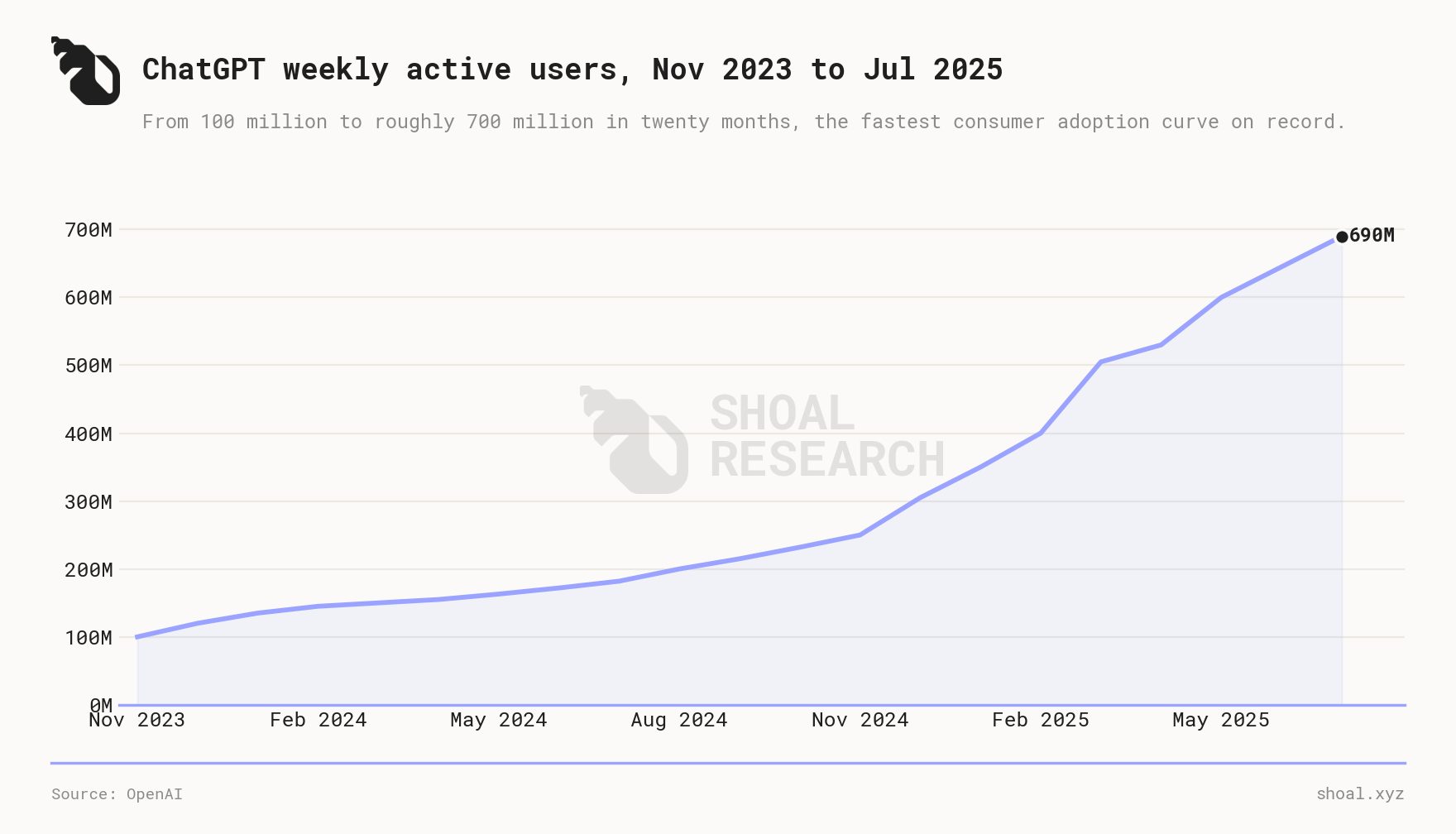
In 2020, OpenAI released GPT-3, and a few years later the world was introduced to ChatGPT, which to many was the first application that actually resembled some form of reasoning. ChatGPT answered a wide range of questions, wrote essays, translated languages, and produced working code, often from nothing more than a short prompt. These capabilities struck a chord, as ChatGPT reached one million users in five days and roughly 100 million monthly users within two months of launch, marking the fastest adoption of a consumer application recorded at the time.
Though ChatGPT initially ran on GPT-3.5, the unlock traced back to GPT-3, made possible by the unprecedented scale of its training data. GPT-3 was the third generation of the same underlying GPT model, each generation scaling the parameters of its predecessor by roughly an order of magnitude. For reference, parameters are the building blocks that support a model's core function of identifying and reproducing patterns, so more parameters means more capacity to do so. GPT-1 held around 117 million parameters, GPT-2 around 1.5 billion, GPT-3 175 billion.
Each jump in parameters sought to remove tedious parts of AI model training that were previously thought essential. GPT-1 demonstrated that language ability learned from raw text could transfer to specific tasks with far less task-specific data than starting from scratch. The model was first pre-trained on large amounts of unlabeled text to predict the next word, then fine-tuned on a smaller labeled dataset for each specific task.
Fine-tuning was the tricky part since every new task still needed its own round of fine-tuning and its own labeled examples, therefore GPT-2 tested whether fine-tuning was necessary at all. The idea was that a language model trained on enough varied text is already a multitasker that is capable of handling tasks it was never fine-tuned for, because the training text is full of them. Testing this capability meant scaling up the GPT model’s inputs, so OpenAI raised the parameter count more than tenfold, to 1.5 billion, and trained on a larger, more diverse web corpus. The largest version reached state-of-the-art results on seven of eight language benchmarks with no fine-tuning at all. Scaling the model, on its own, had removed a step that was supposed to be essential.
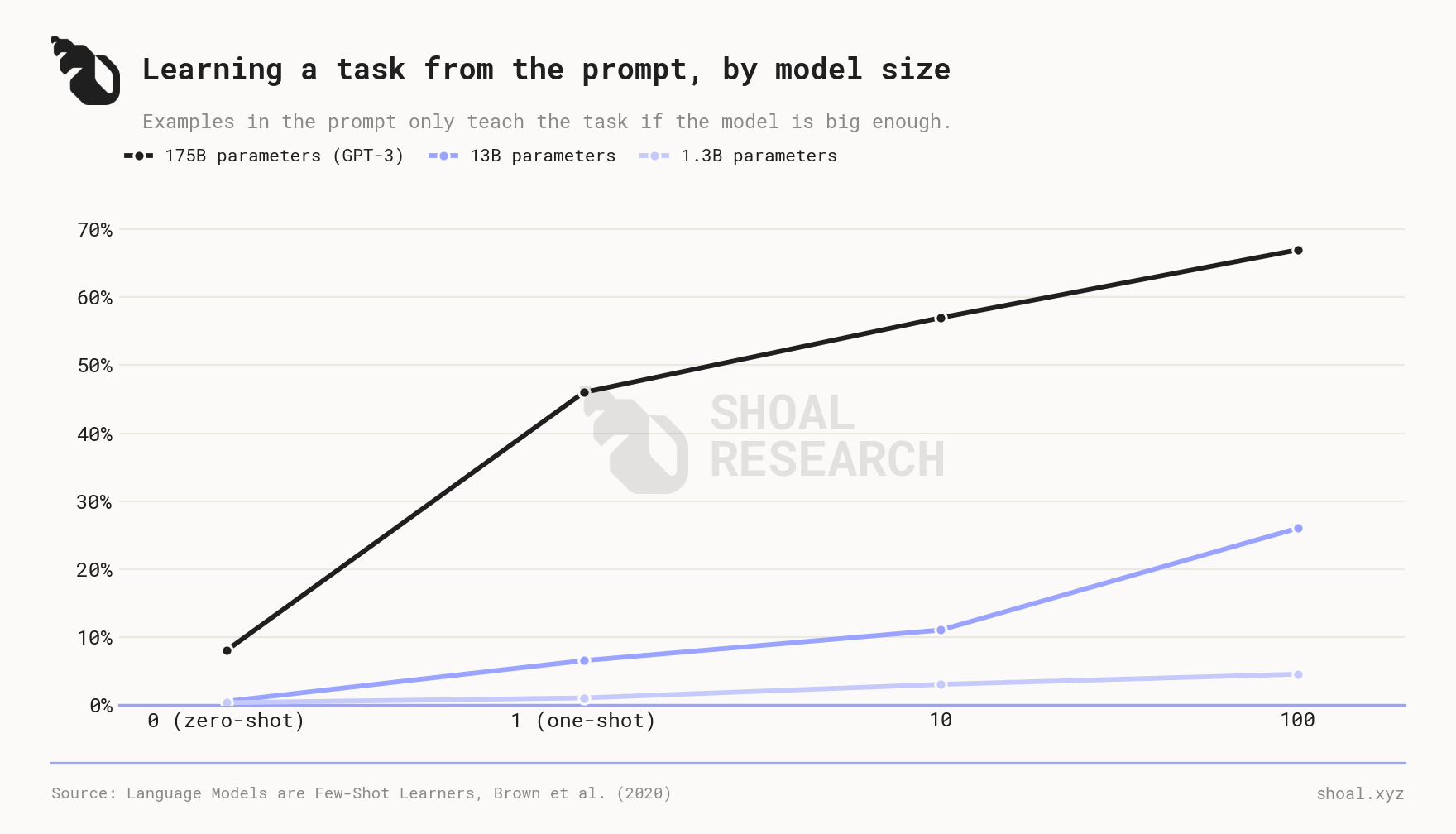
GPT-3 pushed the same bet even further, training 175 billion parameters on about 300 billion tokens of text (a token refers to a chunk of a word) drawn in weighted proportion from filtered Common Crawl, WebText2, two book corpora, and English Wikipedia. With such a dramatic shift in size, capability improved accordingly. GPT-3 could perform a new task from a few examples placed directly in the prompt, with no fine-tuning required.
Though the capabilities of today’s models have well outpaced GPT-3, the model remains a pivotal moment as it laid the groundwork for GPT-3.5 and ChatGPT, and kicked off an AI boom that has reshaped the industry in the years since.
Intelligence Follows Data
Frontier labs, the companies and research organizations building the most advanced models from scratch, OpenAI and Anthropic among them, have actually put those models into production and into the hands of hundreds of millions of users worldwide. In doing so, they’ve drawn tens of billions of dollars in investment and are on pace to become some of the most valuable companies in the world. While a lot of their success is often attributed to the researchers they recruit and the vast computing power they own, none of it would be possible without the massive amount of data their models were trained on.
As GPT-3 demonstrated, building anything resembling the capabilities of a frontier AI model requires a great deal of training data. This is where it’s important to note that not all training data is the same. Raw text scraped from the internet is free and abundant, and can teach a model how language works, what words tend to follow others, how arguments are structured, which facts appear where. Models trained on that scraped corpus grew more capable as the corpus grew in size, and eventually began to generalize to tasks no one had built them for. GPT-3 translated between languages, unscrambled words, and did basic math though it was never trained for any one of those specifically. In fact, GPT-3 had actually beaten XLM, Facebook's leading cross-lingual model, on French-to-English translation, despite never being trained on paired French-English text and working from only a few examples placed in the prompt.
There is a reason models aren’t trained only on scraped text, however, as such models often produce answers that sound convincing whether or not they are correct or helpful. Improving accuracy requires human judgment about which of the model's answers are actually good. A person is shown a prompt and two answers the model produced, and either marks which one is better, reads an answer and corrects its errors, or writes from scratch the answer the model should have given. Each of these judgments becomes a training example, and the model is tuned to prefer outputs like the ones humans preferred, a process known as reinforcement learning from human feedback (RLHF). These judgments are a different and more valuable kind of training data than scraped text, and a more expensive one, since each example must be produced by a person rather than collected from the web. The harder the question, the more qualified the judge must be: a model's answer about tax law should only be graded by someone who knows tax law, so suppliers recruit doctors, lawyers, and engineers to evaluate outputs in their fields. Producing this data at frontier scale is difficult, slow, and expensive. Refining a single model involves hundreds of people over months at costs reaching tens of millions of dollars, and frontier labs spend billions annually.
Models trained on these examples of complete work are more capable of planning a task, carrying it out step by step, and correcting themselves along the way by learning from their prior gathered experiences, and are what we call agents. Agents have become productivity and learning tools at large, and for the frontier labs they have become the fastest-growing product line to date. ChatGPT now serves more than 900 million weekly users, and OpenAI’s revenue run rate hit $40 billion for 2026 after taking in roughly $5.7 billion in the first quarter. Its coding agent, Codex, passed 5 million weekly active users in June 2026, more than six times what it had when the standalone desktop app shipped in February. Claude Code, an agent that performs software engineering work, reached $1 billion in annualized revenue within six months of launch and passed $2.5 billion by February 2026. Anthropic's annualized revenue reached $65 billion over the same period, up from about $1 billion at the start of 2025. In a survey of over 500 US technical leaders conducted by Anthropic and the research firm Material, 86% said they deploy coding agents for production code, and 42% trust them to lead development work under human oversight.
The initial rapid growth of leading AI applications was driven by the breakthroughs in new sectors it was applied to. Every task an agent can currently perform happens on a computer, and though a lot of the world runs on computers today, most of the world and its labor is physical.
The Next Substrate for AI Is Physical
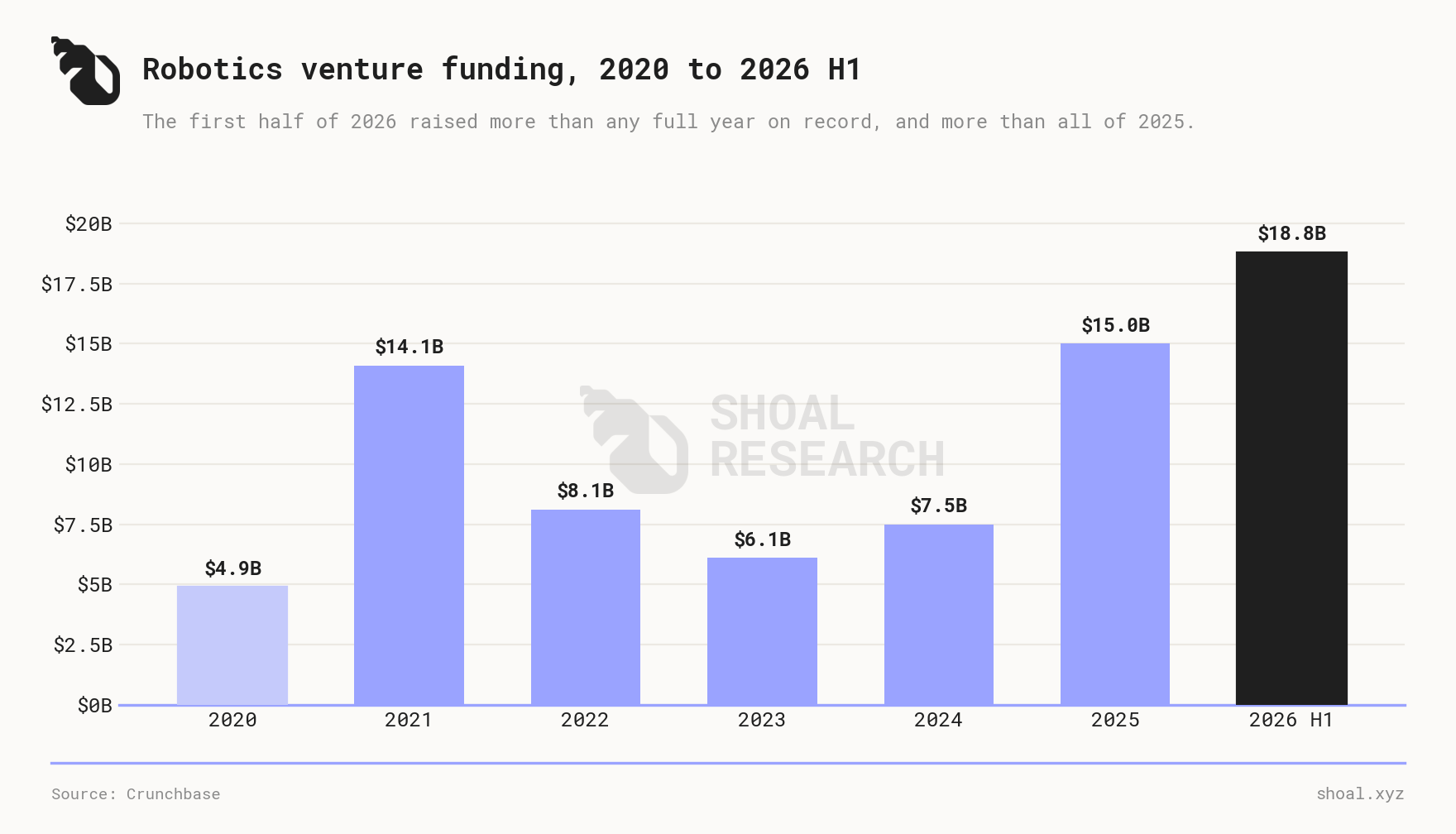
Robotics startups raised $18.8 billion globally in the first half of 2026, up from $15 billion raised in all of 2025 and past the previous full-year record of $14.1 billion set in 2021. SoftBank agreed to acquire ABB's robotics division for $5.4 billion, describing physical AI as its next frontier; Meta acquired Assured Robot Intelligence to train its own physical-AI foundation model; Unitree was recently approved for a Shanghai IPO. Deployments have begun alongside the deals; for instance BMW starting pilot production work with humanoids at a German plant; Japan Airlines putting humanoids on baggage handling at Tokyo's Haneda Airport.
Yet robots have worked in factories since 1961, when the Unimate arm was installed on a General Motors die-casting line in Ewing, New Jersey. The Stanford Research Institute built Shakey, the first mobile robot able to reason about its own actions rather than execute a fixed sequence, between 1966 and 1972. Waseda University completed WABOT-1, the first full-scale humanoid, in 1972.
So why the sudden rise of funding and attention now?
A robot now has something to think with. A robot has to decide what to do before it can do anything, and deciding requires knowing many little details about how the physical world actually works. Language models absorbed a lot of this information from internet text , so a robot can now use one as a brain. But a language model deals with software and outputs words, and a robot deals with the physical world and its output is motions. Vision-language-action (VLA) models emerged as a solution to bridge the physical and software worlds by taking what a robot’s camera sees and the instruction it was given and returns the actual joint movements. Practically, this means robot developers no longer need to write custom code for each unit to only perform a single task at a time, and can operate closer to an AI application given a task in simple plain language to then work out the motion in real time.
The body of a robot got cheaper. A robot sees using cameras and using LiDAR, which fires laser pulses and times how long they take to come back to build a map of what's around it. A LiDAR unit was largely considered prohibitively expensive a decade ago, but phone makers and carmakers then started buying the same sensors in bulk, which drove the price down for everyone, robotics companies included. The costs of motors and joints came down separately, as Chinese manufacturers moved into parts that had been made in small numbers by a handful of Japanese and German firms. A humanoid built from Chinese components now costs around $35,000, and Unitree sells its G1 humanoid at $13,500.
Greater intelligence and cheaper hardware are critical to the advancement of robots and their capabilities, but just like AI models, everything first depends on the underlying training data. To understand why this data is so valuable, it helps to first refresh on what robots actually are.
Understanding Robots
Formally, a robot is an autonomous machine that can sense its environment, think and make decisions, and perform actions in the physical world. In simpler terms, a computer with a physical body.
Nearly all robots are built from the same components, each with a biological analog to a human body. The bones, usually metal, are made up of rigid segments called links. Links are connected by joints, which facilitate movement. Sensors make up the machine’s sensory organs, which includes both* proprioceptive* sensors to measure the position of the robot’s own links, and* exteroceptive* sensors to measure the robot’s environment. Actuators, most commonly electric motors, function as the robot’s muscles, delivering force to the links through transmission (such as gearing) to increase force while proportionally reducing speed for the limbs to produce slow, strong movements. Copper wiring then delivers power to the actuators, while signal travels back the other way through a data bus, a shared line that every joint and sensor connects to, each message tagged with the address of the part that sent it. Power arrives either through a cable to the wall, as on most factory arms, or from a battery the robot carries.
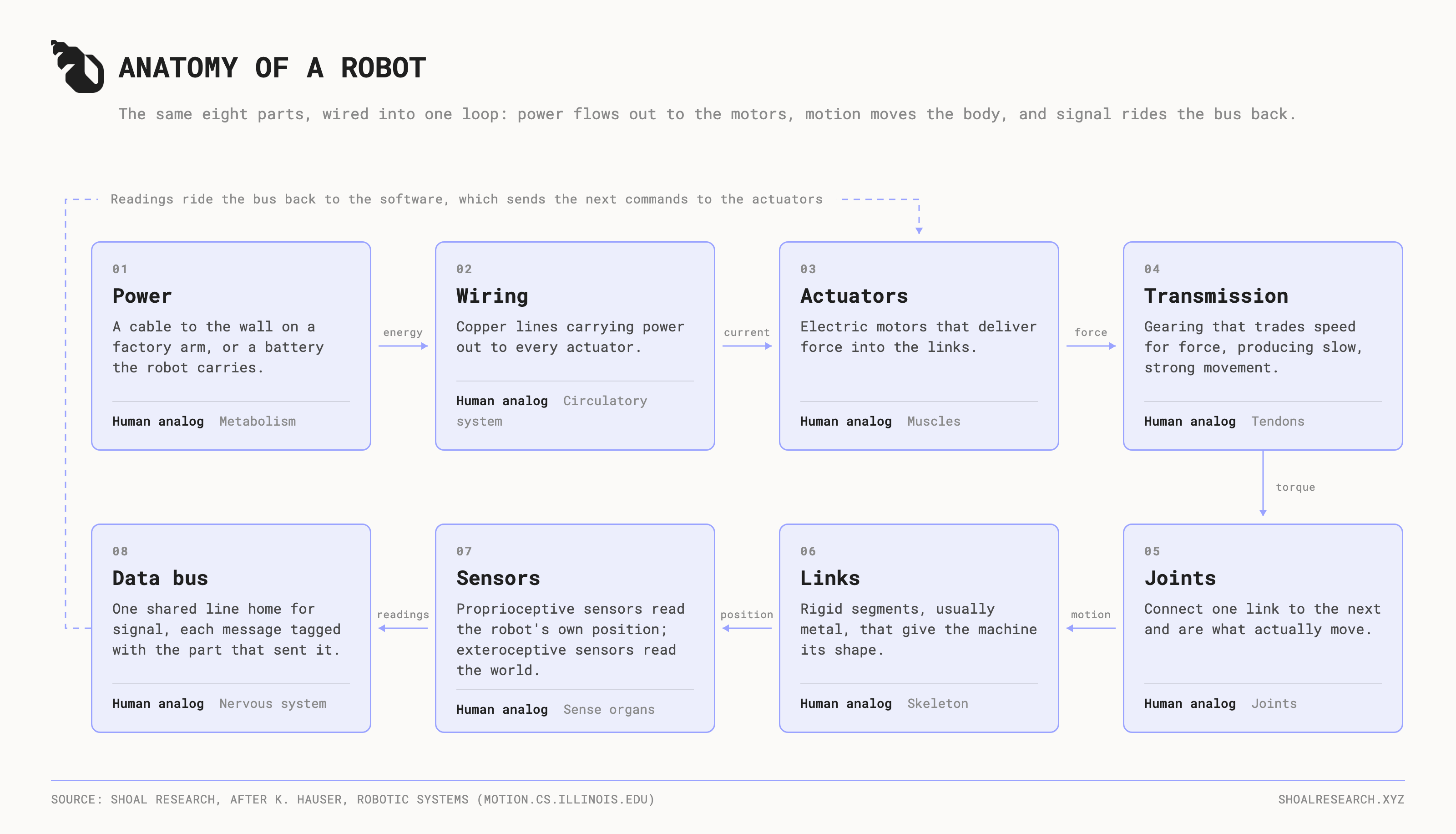
A feedback loop then binds together these various physical parts to enable the robot to actually perform physical operations, record the process, and improve upon its learnings. More precisely, the robot’s software receives information from the sensors, processes it to determine what to do next, and sends commands to the actuators, which apply force to whatever is in front of them; the sensors then read the result, and the loop closes. Roboticists call this the sense-plan-act framework: find out what is happening, decide what to do, make it happen, and learn from each observation.
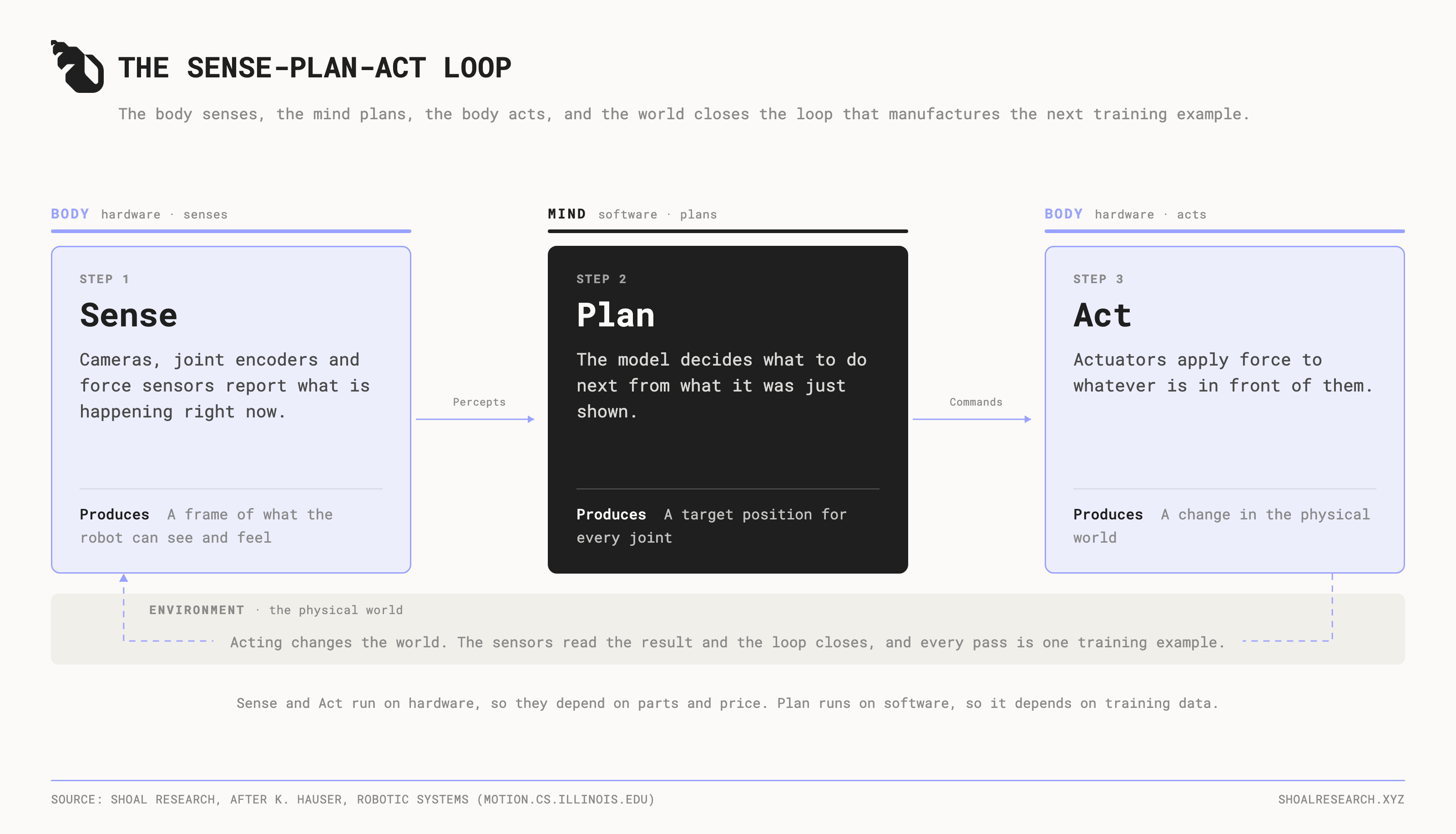
Sensing and acting are hardware-based functions, so how well they run depends on the parts available and what they cost. Planning, on the other hand, is software-based, and largely depends on the availability and quality of training data.
Understanding Robot Training Data
A robot learns how to do a task from recordings of that task being performed, each of which pairs two synchronized streams: 1) what the cameras and sensors registered, and 2) what motor commands were issued in response at that same moment. From enough of these pairs, the model can start to map together how to go from seeing tasks being done to doing them.
Programming this process worked fine with a single stationary task where the motion can easily be written out once and repeated (consider how a robot arm placing stamps on a factory line meets the same panel in the same position at the same moment). But any task with some degree of variance and uncertainty (which most things in life tend to be) makes this more complex, particularly because there are plenty of subconscious decisions being made in real time, most of which are only learned from experience and intuition (nobody thinks how hard to pinch a shirt or how hard to close a hand around a mug to pick it up). Therefore rather than trying to describe that subconscious knowledge into a specification, robotics developers capture it by recording the task being done live.
A robot’s model (its brain) needs to answer a simple straightforward question: based on what the cameras and sensors are showing right now, what should the motors do next? Camera images along with readings from the sensors in the robot’s joints and fingers are shown together with the exact motor commands a competent performance produced at each moment. The internet contains a vast supply of video content, but most lack these two specific requirements a robot needs in order to learn from. There are several different ways to produce and collect robotics training data today.
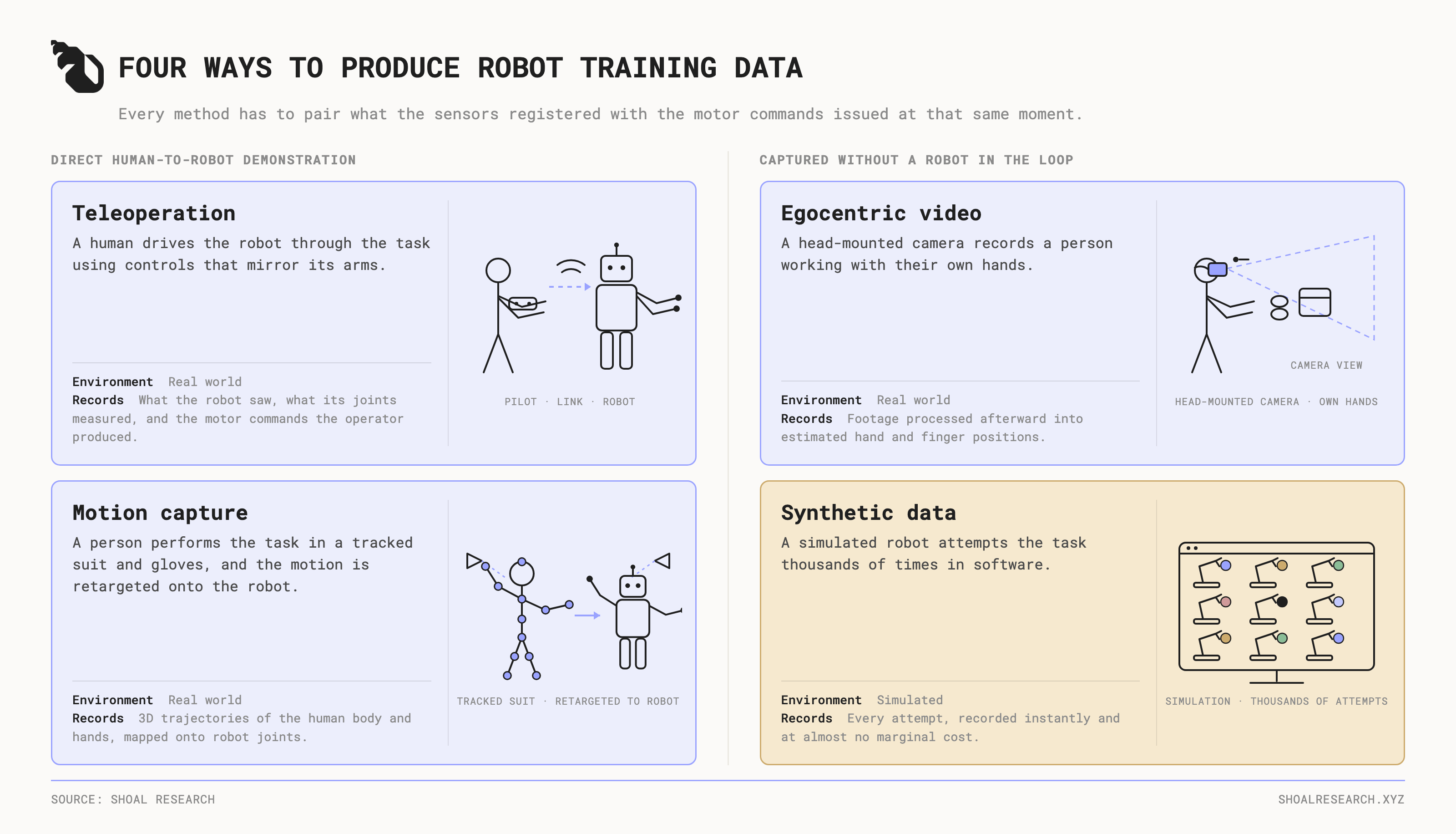
Teleoperation: A human controls the robot directly and performs the task through the robot's body, using motion-tracking equipment or controls that mirror the robot's arms, while the system records what the robot saw, what its joint sensors measured, and what motor commands the operator's movements generated.
Motion Capture: A person performs the task wearing tracked markers or a sensor-equipped suit and gloves, which produces precise 3D trajectories of the body and hands that are then retargeted onto the robot's joints.
Egocentric Video: A head-mounted camera records a person doing tasks with their own hands, and software processes the footage afterward, estimating hand and finger positions frame by frame and translating them into equivalent robot motions.
Synthetic Data: A simulated robot attempts the task in a simulated environment, and the attempts are recorded as training examples.
It’s important to note that a model trained only on demonstrations runs into a ceiling inevitably, because most demonstrations only show the task going well, so the model never sees a mistake and never learns what to do when encountering one. The common solution is to turn data production into a loop itself, known in formal robotics terms as DAgger (Dataset Aggregation), a form of interactive imitation learning. Human demonstrations train an initial model, the robot then attempts the task itself, and when it makes a mistake, a human operator takes over through teleoperation, corrects the mistake, and hands control back to the robot, while the correction is incorporated into the robot’s training data for future reference. Robotics teams generally aim to end with the robot practicing on its own, its attempts scored against a defined set of rules in order to reinforce successful behaviors, though in practice today most of the work is still in the earlier stages with a human closely involved in the loop.
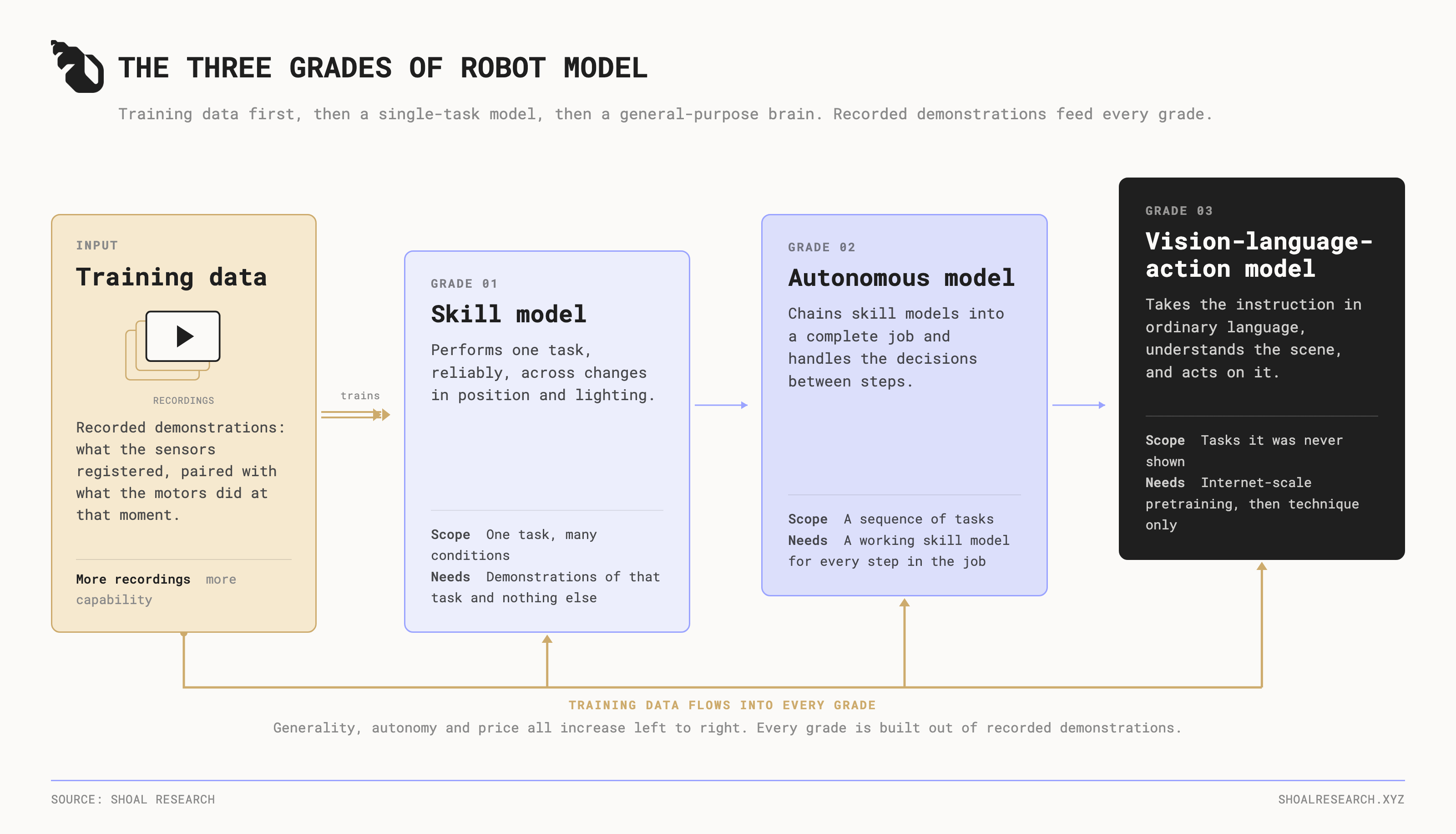
The training loop’s output is what we can call a robot “brain”: a trained model capable of taking in what its cameras and joint sensors report at a given moment, and returning the motor commands that come next. Models today are sold in three grades, each with varying levels of autonomy for the robot.
The first grade is the skill model, the narrowest model, which is produced by running the training loop to perform a single task, with slight variance across its environments. While it sounds similar to factory-line robots purpose-built for a single repeated motion, a skill model learns how to perform its sole task across different conditions (e.g. performing the task in a different position, or using different lighting). Second is the autonomous model, which chains together different skill models into a complete job, and handles the decisions between each step, invoking each individual skill model as needed. The third grade of model, what is widely accepted as the ‘frontier’ today, is the vision-language-action model, or VLA: single trained system that combines seeing, understanding an instruction in ordinary language, and acting on it. The design borrows from language models, and in several leading implementations actually implements them: a large vision-language model, the same kind of system behind a chatbot, handles the slow high-level reasoning of understanding the scene and planning what to do, while a second, faster component turns that plan into continuous motor commands many times per second.
Because a VLA inherits general knowledge from internet-scale pretraining, it arrives already knowing things nobody taught it, which changes how new capability gets added. A skill model knows nothing outside its task, so a new task means building it from nothing, demonstration by demonstration. A VLA can be given the task in ordinary language and already has some grasp of the objects and the goal, so its demonstrations only need to supply the physical technique rather than the technique and the objects and the concept of the task all at once.
The Data Bottleneck
Every method of producing this data shares the same underlying constraint, which is that a physical performance still needs to happen for the data to exist in the first place. A demonstration takes as long to record as the task takes to perform, and for that entire time it occupies a robot, workspace, and human operators. When language models needed more data, AI labs turned to more web crawling and hiring more human data labelers, whereas when a robot needs more data, the solution requires more robots, more human operators, and more hours in the warehouse.
Models do transfer some general ability across tasks, but performing a new task reliably still tends to require demonstrations of that specific task, and every task comes with variations (e.g. different objects, layouts, lighting etc) which all need their own coverage. Therefore it’s difficult to imagine demand for demonstrations slowing down any time soon. Models may eventually pick up new tasks from a handful of examples the way language models did, but as GPT-3 and its successors demonstrated, a step-function change in capabilities can only come from an exponential increase in training data and inputs.
The Big Opportunity In Robotics Is the Data Layer
Robotics startups raised more in the first half of 2026 than in all of 2025, which was itself a record. The gap between enthusiasm and reality, the demand for robotics vs their actual capabilities today, is still rather wide. Simply put, there’s plenty of demand for robots, but today’s robots are still not very good just yet. Robotics developer Unitree shipped more than 5,500 humanoids in 2025 per company filings, the highest volume in the world, meanwhile the marquee industry deployments at names like BMW, Mercedes, Amazon, are all pilots involving just a few dozen machines. An industrial buyer needs a machine that works 95-99% of the time, and the current humanoids work for 30-90 minutes before they need a recharge or a person to step in. Robot hands cannot reliably handle objects that vary, and their brains, despite all the advances in frontier lab models over the past several years, still get confused by the variance and unexpected intricacies of physical reality.
The first three GPT models established that the most effective way to close a capability gap is to give a model more high-quality data. The caveat here is that the data these language models needed is already largely abundant, thanks in no small part to humans recording and documenting history for centuries. The data a robot needs is multimodal, time-synchronized, and physically captured, which means it cannot be scraped the way text can and has to be manufactured by people operating robots and recording rigs. The labeling does not parallelize the way text labeling does either, because judging whether a plate was placed securely or precariously takes physical intuition rather than pattern matching, so the annotation workforce cannot simply be scaled out to thousands of remote workers.
Everyone building robots, from the robot makers and the model labs alike, needs this data, but there is no shortcut to acquiring it. What exists in public datasets rarely transfers to a specific robot, and producing data in-house means running warehouses, fleets, human operators, and incurring all of the associated costs. Something similar already played out in software, where frontier labs needed human judgments and expert-written examples that were not sitting on the internet, and the suppliers who produced them (e.g. Scale, Surge, Mercor) grew into a category with roughly $8.5 billion in revenue.
The Path Forward Is Vertical
A useful comparison is chip manufacturing. Designing a chip and building one are separate businesses: the design is intellectual property, while the factory that etches it into silicon costs tens of billions and only pays off if it runs near capacity. So most chip companies stopped owning factories; Nvidia, Qualcomm, and Apple all design chips and manufacture none of them, leaving that to TSMC, which builds nothing of its own and now makes nearly all of the world's most advanced chips.
The robotics data layer is valuable but it’s not so easy to occupy, let alone succeed in. A demonstration recorded on one specific robot’s body, and its associated dataset, cannot be transferred over to another robot, which means a data vendor has to rebuild its product for every individual customer. And as we mentioned earlier, there is also a limit to what demonstrations alone can teach, since they show the task going right; the model still has to learn what to do when it goes wrong (and a human operator is often required to intervene in training). A customer looking for robotics training data isn’t as interested in the raw data as they are in the ability to keep making the data as their robot changes. This requires 1) robots to record on, 2) real work for those robots to do, and 3) a pipeline carrying each failure back into the next model. There is now a unique opportunity for a business, by owning all three components, to own the training data layer for robotics.
Eastworlds
One team actively working on capturing this emerging opportunity is Eastworlds, the new robotics division of Virtuals Protocol. In practice, Eastworlds is a neodeployment robotics lab and accelerator for robotics and embodied AI startups. The team operates from Kuala Lumpur, and runs the largest fleet of Unitree G1s in Southeast Asia (30+) with research partnerships with universities including Carnegie Mellon University and Nanyang Technological University.
The Eastworlds’ business model revolves around robot data collection and neodeployments. Data collection covers teleoperation and gripper data, video, proprioceptive, action capture, dataset review and QA, as well as policy improvement datasets, including human corrections and the associated recovery data. Alongside data collection, Eastworlds also specializes in neodeployments, which involves placing robots into commercial settings that have never used them before, where the machine does paid work under teleoperation while the work itself produces the recordings. The customer buys labor, while generating data for Eastworlds.
Autonomy for robots, as we mentioned earlier, is not ready yet and a business owner will not put a robot that might fail near their goods or their customers. By contrast, a teleoperated robot is reliable enough to sell today because the reliability comes from the human operator rather than the model. The fastest route to a commercial contract is therefore to sell the teleoperated version of the job now, which is what Eastworlds built: a low-latency teleoperation that lets an operator in Asia control a humanoid in the United States or Australia. In early 2026, Eastworlds started rolling out pilot programs with hotels, malls, security, shelf-stocking, and hydroponic-farm work per Virtuals founder Jansen Teng.
Every deployment generates data, typically unstructured and heavy on edge cases since it comes from live operations, captured as egocentric teleoperation data, multi-modal sensory inputs, and task execution feedback, and accumulated in what the company calls its Embodied AI Data Lake. In the near term that data retrains the models running the fleet, so each robot fails less at the job it is already doing, and over a longer horizon the accumulated dataset becomes training material for next-generation VLA and world action models, carrying the G1 fleet from teleoperation toward full autonomy.
Eastworlds also runs an incubator, funding vetted teams and giving them month-long access to a robotics fleet, facility, and teleoperation stack, with each team pursuing its own commercial use case. Seven teams were in residence according to Teng, working across entertainment, oil and gas, grocery, and hotel management, with capacity planned for more than twenty. Each team runs its own deployments on the shared fleet and surfaces its own failures and fixes, and both the learnings and the data flow back into the Data Lake, which applies the same mechanics driving Virtuals' agent ecosystem to robots.
Eastworlds integrates Virtuals Protocol's onchain infrastructure to handle the economics of its data operation. Eastworlds operates through a distributed business model, involving thousands of hours of recording and teleoperation, performed by many people in many places, with quality needing to be verified before payment. Hiring such a workforce requires building payroll and oversight in every geographic region involved. An alternative approach is using incentives, where the task and reward are posted, contributors opt in from anywhere, and payment quickly follows verified delivery. Enabling such a mechanism at scale requires a programmable, global, low-cost payment rail to run on, which Virtuals already runs for software-based AI agents to raise capital, transact, and settle payments programmatically on Base and Solana. Eastworlds applies the same design to robot training data, using token incentives to recruit and pay a distributed workforce.
The market for this data is already paying. Buyers pay roughly $3 to $10 for an hour of egocentric recording and $50 to $100 for an hour of teleoperation, rates above typical hourly wages in much of Asia, per Teng. Traditionally, token incentive campaigns tend to collapse once new participants stop arriving, because nobody outside the system is buying anything, whereas here the incentives are backed by paying customers, namely the labs buying the data, so the pool holds for as long as demand for the data does.
Putting everything together, Eastworlds’ roadmap roughly looks as follows: sell data and neodeployments today (because buyers already pay for both), use those paid deployments to collect what staged collection cannot produce, particularly the corrections; then use the growing Data Lake to train models, starting with single-task ones and moving toward more general ones, each of which sells for considerably more than raw data does. Eastworlds operates at the data layer, but its moat is everything required to keep making the data, including the G1 fleet, the operators, the incubated teams, the live deployments, and the payment rails underneath them.
Risks and Important Considerations
There are, of course, risks and important considerations around scaling the robotics data layer to keep in mind. The deepest objection, to the category as a whole, is that teleoperation may not lead to robot autonomy after all; a robot that needs an operator to get through a hotel shift is doing the shift with a person either way, just in addition to a robot and its associated costs. Teleoperation vendors and the robot makers argue this is a temporary phase for activities where the variation is small and the failures repeat, and the model does keep improving until the operator stops intervening altogether. The tasks that made robots hard in the first place, where the objects, the layout, and the failure modes keep changing, are the ones where the operator never fully leaves today. Those are also the tasks that generate the most valuable data, which is why a supplier is well-positioned to remain profitable in a world where full autonomy never truly arrives.
Simulation threatens demand for recorded demonstrations, which is the product a data supplier sells. An operator recording by hand produces somewhere between 5 and 50 episodes an hour, while a simulator runs millions overnight at almost no cost. What simulation still gets wrong is contact, since the moment two objects touch, the simulated physics and the real physics diverge, which is why simulated data alone does not produce a robot that can pick things up. Teams are closing that gap by randomizing the conditions in the simulator (e.g. lighting, textures, friction) so a model does not overfit to any one rendering, and by tuning the simulator's physics settings until a simulated arm moves the way the real arm does.
The price of robotics training data itself has fallen too. Per SVRC's State of Robotics 2026, an hour of high-quality teleoperation data cost roughly $340 in early 2024, $136 by the fourth quarter of 2025, and is down to $118 by March 2026. This decline was driven by 1) leader-follower rigs (setups where an operator moves a small replica arm and the robot copies it) dropped under $2,000, so a site no longer needs custom hardware; 2) software like DROID and LeRobot now takes raw operator recordings and formats them into training-ready datasets without a person doing the cleanup. Both are still improving. A supplier whose product is recorded hours is, therefore, selling into a market where the price of an hour dropped by ~66% in two years.
Competing robotics data suppliers arrived at vertical integration at the same time Eastworlds did: Adamo sells managed teleoperation with sub-40-millisecond control software so robot companies can skip building the operation themselves, XDOF, founded in October 2024, moved beyond selling recordings into cleaning, tooling, and annotation on its founders' reasoning that selling recordings alone is a dead end, and Physical Intelligence, Lux, iMerit, and DataX Power all sell some version of managed collection plus the tooling around it, with DataX Power running its programs out of Southeast Asia, the same region Eastworlds operates in. None of them, however, run paid commercial deployments of their own, which is where corrections come from and which is the part of the loop that cannot be replicated by hiring more operators into a warehouse. The crowding is real at the collection layer and thin at the deployment layer.
Robot makers are, of course, a harder problem, because several of them already produce training data in-house: Figure runs its own teleoperation fleet across its BMW deployment, and Tesla's Optimus program is built on the same loop of deploying robots, recording the failures, and retraining on them, and those operations own the hardware, the deployment, and the customer relationship already, which means they accumulate data faster than anyone buying it. The data they accumulate, though, is data on one robot doing one company's work, and a supplier serving twenty customers across hotels, farms, and warehouses collects a spread that no single manufacturer's fleet produces. Figure and Tesla are also the two best-capitalized robotics teams in the world, and the dozens of robot makers below them cannot fund an operation of that size, which is the market an independent supplier would actually sell to.
Lastly, Eastworlds’ economic model and token mechanism carries its own risks. Paying contributors in tokens avoids setting up payroll and compliance in every country where someone records an hour of footage, but it ties what a contributor earns to the token price rather than to the work they did, so recruitment gets hardest during a drawdown, which is precisely when the operation most needs steady output. The legal treatment of paying workers this way is also unsettled across most of the jurisdictions involved. Eastworlds' answer is that customer revenue funds the incentives rather than new token buyers, which is, of course, the correct structure, since it means the pool does not depend on new participants arriving. That structure holds as long as the customers do, and a supplier whose contributor base is priced in a volatile asset has a second failure mode that a payroll-based competitor simply does not have.
Closing Thoughts
Eastworlds is building a picks-and-shovels business for the emerging robotics field, particularly around the training data layer. The software version of this already ran its course: frontier labs fought to create the most cutting-edge models, hundreds of billions were spent, and the companies that sold them their training data, Scale and Surge and Mercor, grew into multibillion-dollar businesses that got paid regardless of which customer won.
That rush has now moved beyond software and into the physical world. Robots have brains borrowed from language models and cheap bodies mass-produced largely by Chinese manufacturers, and every serious lab and robot maker is chasing the same machine that can do physical work on its own. What none of them can skip is the examples of physical work to learn from, which cannot be scraped and largely have to be produced by people operating robots, one recorded session at a time. Pooled public datasets help a model start, but the building a robot works in, the hardware it runs on, and the ways it specifically fails all have to be recorded fresh, so demand renews with every deployment rather than being satisfied once.
A supplier that only sells raw demonstrations is easy to replace and easy to squeeze, since the recordings transfer poorly between robots and a few customers often account for most of the revenue. A supplier that also has a robot fleet, employs operators, manages the deployments, and carries each field failure back into the next model becomes a business whose customers cannot easily leave or rebuild, doing what would otherwise take five vendors. That is exactly what Eastworlds is building. Its Unitree fleet does paid pilot work in hotels and malls today, its operators step in when the autonomy fails, and both come out the other side as training data, offered as demonstrations and corrections, collected into the Data Lake. Although data is the biggest bottleneck in robotics today, the surrounding infrastructure remains heavily fragmented, and there is now a unique opportunity for a business to vertically integrate and own as much of the robotics data layer as possible. Eastworlds is well-positioned to capture this opportunity, but only time will tell if it does.
References
Anthropic. (2026). The 2026 state of AI agents report: How enterprises are building and deploying AI in production. https://resources.anthropic.com/hubfs/The%202026%20State%20of%20AI%20Agents%20Report.pdf
Bloomberg News. (2026, May 1). Meta acquires Assured Robot Intelligence to help build humanoid technology. Bloomberg. https://www.bloomberg.com/news/articles/2026-05-01/meta-acquires-assured-robot-intelligence-to-help-build-humanoid-technology
BMW Group. (2026, May 13). BMW Group to deploy humanoid robots in production in Germany for the first time [Press release]. https://www.press.bmwgroup.com/global/article/detail/T0455864EN/bmw-group-to-deploy-humanoid-robots-in-production-in-germany-for-the-first-time?language=en
Brohan, A., Brown, N., Carbajal, J., Chebotar, Y., Chen, X., Choromanski, K., ... Zitkovich, B. (2023). RT-2: Vision-language-action models transfer web knowledge to robotic control. arXiv. https://arxiv.org/abs/2307.15818
Brown, T. B., Mann, B., Ryder, N., Subbiah, M., Kaplan, J., Dhariwal, P., ... Amodei, D. (2020). Language models are few-shot learners. arXiv. https://arxiv.org/abs/2005.14165
Chollet, F. (2019). On the measure of intelligence. arXiv. https://arxiv.org/abs/1911.01547
Eastworlds. (n.d.-a). Data. https://eastworlds.io/data
Eastworlds. (n.d.-b). Eastworlds whitepaper. https://whitepaper.eastworlds.io/
Harvard Business School. (2026, June 1). Who's adopting AI agents, and what they're actually doing with them. HBS Working Knowledge. https://www.library.hbs.edu/working-knowledge/whos-adopting-ai-agents-and-what-theyre-actually-doing-with-them
Hauser, K. (n.d.). Anatomy of a robot. In Robotic systems (draft). University of Illinois Urbana-Champaign. https://motion.cs.illinois.edu/RoboticSystems/AnatomyOfARobot.html
OpenAI. (2023-2025). ChatGPT weekly active user milestones [Company disclosures]. https://openai.com/news/
Perrigo, B. (2025, June 16). How Meta's $14 billion deal upended the AI data industry. TIME. https://time.com/7294699/meta-scale-ai-data-industry/
Reuters. (2026, July 3). Chinese robot maker Unitree wins approval for $619 million Shanghai IPO. Yahoo Finance. https://finance.yahoo.com/technology/articles/chinese-robot-maker-unitree-wins-052743978.html
Rider, J. (2026, June 22). Sector snapshot: Robotics startups on fire as venture funding surges to record numbers in 2026. Crunchbase News. https://news.crunchbase.com/robotics/startup-venture-funding-surges-2026-data/
Robotics Center of Silicon Valley. (2026). State of robotics 2026: Annual report on the global robotics industry. SVRC Research. https://www.roboticscenter.ai/state-of-robotics-2026
Shaip. (2026, June 9). Robot training data and manipulation datasets: 2026 guide. https://www.shaip.com/blog/robot-training-data-and-manipulation-datasets-power-real-world/
SoftBank Group Corp. (2025, October 8). Acquisition of ABB Ltd's robotics business [Press release]. https://group.softbank/en/news/press/20251008
SRI International. (n.d.). Shakey the robot. https://www.sri.com/hoi/shakey-the-robot/
The Rollup. (2026, April 15). Jansen Teng on why robots need crypto to scale [Video]. YouTube. https://www.youtube.com/watch?v=u5ZuftUNnT8
Not financial or tax advice. The purpose of this post is purely educational and should not be considered as investment advice, legal advice, a request to buy or sell any assets, or a suggestion to make any financial decisions. It is not a substitute for tax advice. Please consult with your accountant and conduct your own research.
Disclosures. All posts are the author’s own, not the views of their employer. This post has been created in collaboration with the Eastworlds team. At Shoal Research, we aim to ensure all content is objective and independent. Our internal review processes uphold the highest standards of integrity, and all potential conflicts of interest are disclosed and rigorously managed to maintain the credibility and impartiality of our research.
Scraping text from the web built trillion-parameter language models. It won't build a robot that can reliably stock a grocery shelf. 🤖
The physical world demands a completely different training substrate. You can't scrape motor commands off a webpage. Every frame of video must align perfectly with joint positions, sensor streams, and torque output. That reality is why funding for robotics hit $18.8 billion in early 2026. Hardware costs are collapsing fast. Unitree sells its G1 humanoid for $13,500 today. The body got cheap. The brain remains starving for data. 🧠
Most teams fall into the demonstration trap. They record thousands of hours of clean teleoperation where nothing goes wrong. That data creates fragile policies. The moment a mug slips two millimeters, the model panics because it never saw a recovery state. True progress happens inside the DAgger loop. You need the robot to fail, step in via remote operator, correct the trajectory, and log that exact failure mode into the training set. 🛠️
This need for live failure recovery explains why vertical data collectors are taking over. Eastworlds runs a fleet of G1 humanoids out of Kuala Lumpur, selling actual teleoperated labor to hotels and farms in the US. The customer pays for the work. The operator captures the edge cases. The data flows back into an Embodied AI Data Lake, using Virtuals Protocol's token rails on Base and Solana to settle payments with operators worldwide. 🌍
Here's the dirty secret about teleoperation data. Human operators don't feel what the robot feels. When a human controls a robot arm over a network, they rely on camera feeds that lag behind real contact. They apply micro-corrections based on visual estimation rather than force feedback. This introduces high-entropy human jitter directly into the training distribution. The neural policy tries to memorize that random jitter as meaningful logic. Without real-time haptic feedback embedded into the bitline registers at the joint level, raw teleoperation data carries a hidden expiration date. 📉
Data prices already dropped from $340 an hour down to $118. As raw recording hours commoditize, where does the real moat live? Will independent data pools win, or will Tesla and Figure lock up physical AI simply because their deployed fleets generate millions of failure corrections every single day? ⚡
(⚙️_⚙️)